Українська
    Login
    ProductGalleryShryftorizPublic offer
    CompanyAbout us
    ConnectInstagram
    Copyright© 2026
    Designed and built by NGO "Ukraine in Color"
    Current Status: Public Beta
    19 centuryPoltava

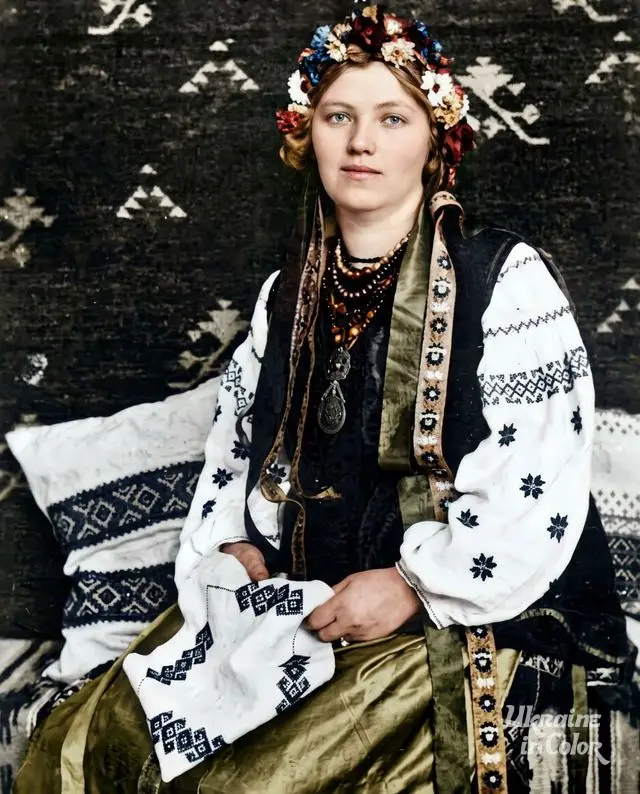
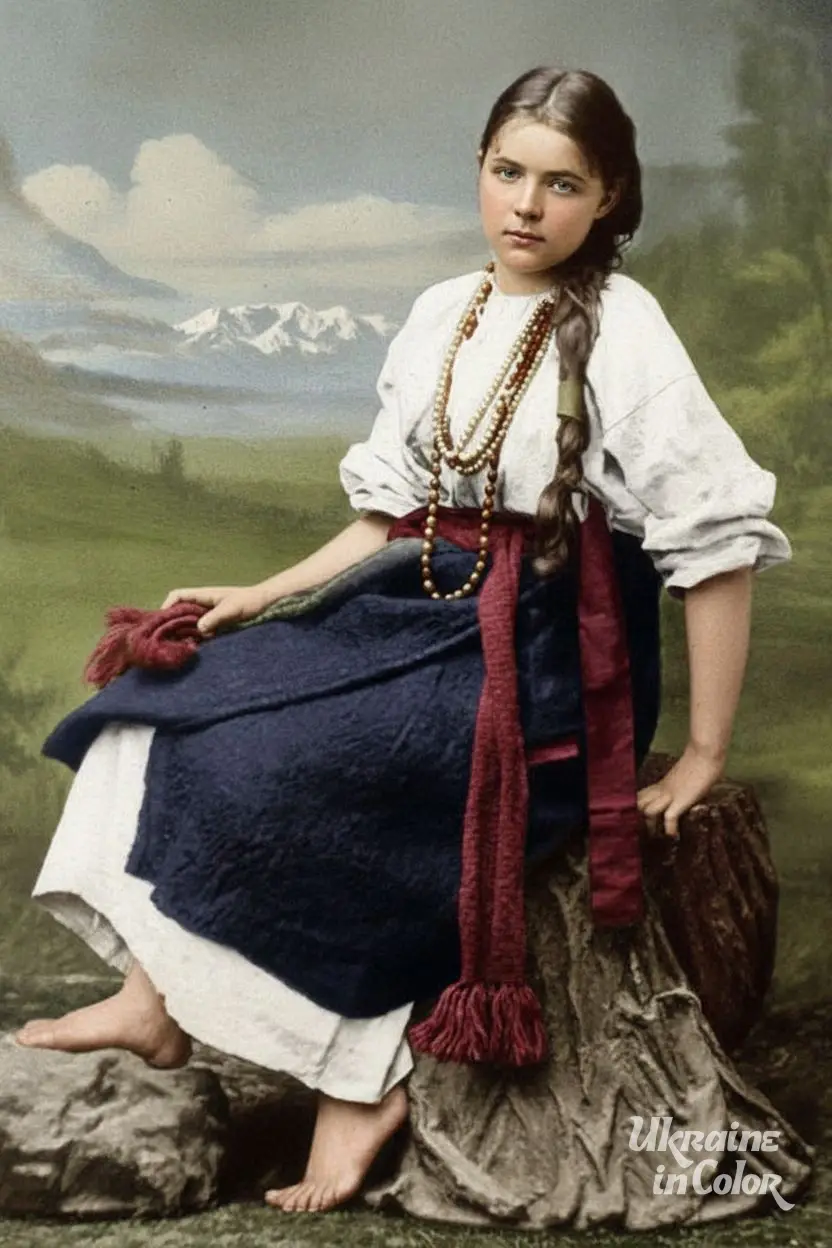
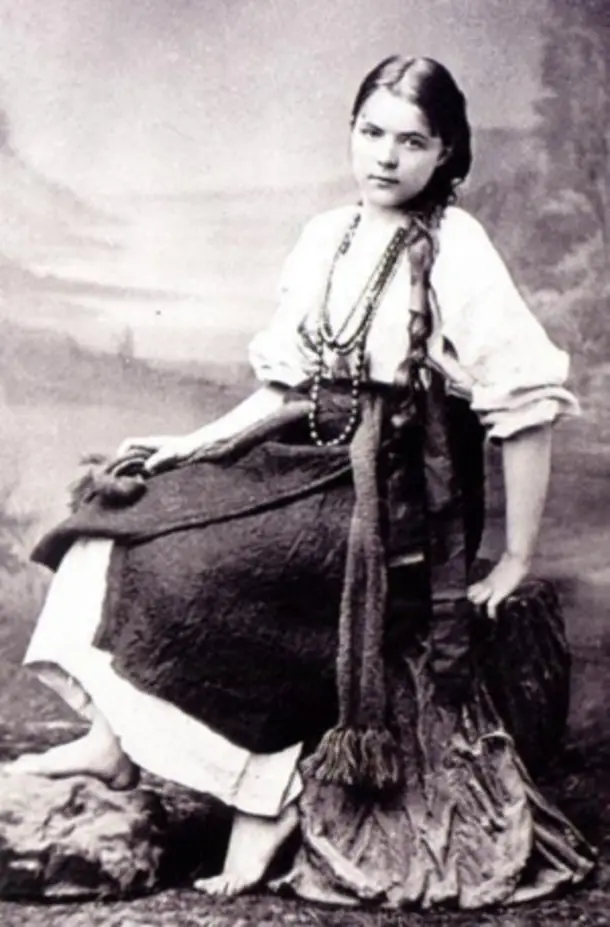
    Marie Bashkirtseff wearing Ukrainian traditional outfit

    In 1876, after years in Europe, 17-year-old Marie Bashkirtseff joyfully reconnected with her roots in Ukraine. Visiting Havrontsi, Chernyakivtsi, and Prince Kochubey’s estate, she wore a traditional Ukrainian costume. This moment was captured by renowned Poltava photographer Józef Chmielewski.
    Depicted:Place: PoltavaOriginal: Fair useRestoration: All rights reserved
    Marie Bashkirtseff
    Postcard portrait: 'Khorunzha Olena Stepanivna. Ukrainian Sich Riflemen', c. 1915
    Postcard portrait: 'Khorunzha Olena Stepanivna. Ukrainian Sich Riflemen', c. 1915A sepia-toned patriotic postcard portrait of Olena Stepaniv from the First World War period. The upper portion bears a printed Ukrainian inscription: 'Khorunzha Olena Stepanivna. Ukrainian Sich Riflemen.' She is shown in USS uniform: a mazepynka cap with cockade, a tunic with embroidered collar; on her chest are her decorations: on her left (the viewer's left) — the silver Austro-Hungarian Medal for Bravery awarded on 10 November 1914 for her role in the Carpathian Campaign; on her right — the insignia of the Ukrainian Sich Riflemen. Likely published in Lviv c. 1915 for patriotic distribution. The original is held by the Museum of Military History (Heeresgeschichtliches Museum) in Vienna, inv. no. 2010_42_738_104.
    Studio portrait of Olena Stepaniv with saber and decoration on her sleeve, in USS uniform, c. 1914–1915
    Studio portrait of Olena Stepaniv with saber and decoration on her sleeve, in USS uniform, c. 1914–1915Full-length studio portrait of Olena Stepaniv in the uniform of the Ukrainian Sich Riflemen: a mazepynka cap with cockade, a tunic with breast pocket, breeches with puttees, and high lace-up boots. She stands with arms crossed on her chest, her right hand resting on an officer's saber stood vertically on the floor. A decoration ribbon is visible on her left sleeve — likely the silver Austro-Hungarian Medal for Bravery she was awarded on 10 November 1914 for her role in the Carpathian Campaign. The backdrop is a studio curtain on the right and a wicker chair on the left. A photographer's stamp is visible in the lower-right corner.
    Full-length studio portrait of Olena Stepaniv with a saber, in USS uniform, c. 1914–1915
    Full-length studio portrait of Olena Stepaniv with a saber, in USS uniform, c. 1914–1915Full-length studio portrait of Olena Stepaniv in the uniform of the Ukrainian Sich Riflemen: a mazepynka cap with cockade, a tunic with breast pocket, breeches with puttees and boots. In her right hand is an officer's saber. The backdrop is a painted studio scene with a balustrade and park architecture. Likely taken in Lviv in 1914–1915, during her active service with the USS before her capture by Russian forces in May 1915.
    Studio portrait of USS officer (khorunzha) Olena Stepaniv, c. 1914–1915
    Studio portrait of USS officer (khorunzha) Olena Stepaniv, c. 1914–1915Studio portrait of Olena Stepaniv in the uniform of a khorunzha (junior officer) of the Ukrainian Sich Riflemen (USS). The eight-pointed star insignia on the collar tabs marks USS officer rank; the mazepynka cap bears a central cockade. The tunic collar is decorated with traditional Ukrainian embroidery. The photograph was likely taken in Lviv during her period of active service (1914–1915), before her capture by Russian forces near Bolekhov in May 1915.
    Postage stamp featuring Olena Stepaniv
    Postage stamp featuring Olena StepanivPostage stamp featuring Olena Stepaniv — part of a series dedicated to prominent Ukrainian women and figures of the Ukrainian Sich Riflemen.
    USS Officers on Mount Makivka: Zenon Noskovskyi, Olena Stepaniv, Ivan Chmola, Osyp Yarymovych, Sofia Halechko
    USS Officers on Mount Makivka: Zenon Noskovskyi, Olena Stepaniv, Ivan Chmola, Osyp Yarymovych, Sofia HalechkoOfficers of the Ukrainian Sich Riflemen on Mount Makivka: Zenon Noskovskyi, Olena Stepaniv, Ivan Chmola, Osyp Yarymovych, and Sofia Halechko. Mount Makivka (Skole Beskids, Carpathians) was the site of the USS battle against Russian forces in April–May 1915, in which Olena Stepaniv participated and for which she received the silver Medal for Bravery.
    Funeral of Olena Stepaniv at Lychakiv Cemetery, July 13, 1963
    Funeral of Olena Stepaniv at Lychakiv Cemetery, July 13, 1963The funeral of Olena Stepaniv at Lychakiv Cemetery in Lviv, July 13, 1963. She died of cancer on July 11, 1963, in Lviv.
    House at 11A Kozatska Street, Lviv, where Olena Stepaniv lived after the camps
    House at 11A Kozatska Street, Lviv, where Olena Stepaniv lived after the campsHouse at 11A Kozatska Street, Lviv, where Olena Stepaniv lived with her son Yaroslav Dashkevych after her return from the Mordovian camps. Photograph from the 1960s.
    Olena Stepaniv with her son Yaroslav Dashkevych, 1958
    Olena Stepaniv with her son Yaroslav Dashkevych, 1958Photograph of Olena Stepaniv with her son, historian Yaroslav Dashkevych (1926–2010), taken in 1958, after her release from the Mordovian labor camps (1949–1956).
    The return of Olena Stepaniv from Russian captivity, 1917
    The return of Olena Stepaniv from Russian captivity, 1917Photograph taken during the return of Olena Stepaniv from Russian captivity (Tashkent → Europe) in July 1917.
    Olena Stepaniv with a wounded officer in Tornio during her return from captivity, summer 1917
    Olena Stepaniv with a wounded officer in Tornio during her return from captivity, summer 1917Olena Stepaniv with a wounded officer in Tornio (then the Finnish-Swedish border station on the prisoner-exchange route) during her return from Russian captivity, summer 1917.
    Front page of an Austrian periodical featuring Olena Stepaniv after her return from captivity
    Front page of an Austrian periodical featuring Olena Stepaniv after her return from captivityFront page of an Austrian periodical with a photograph of Olena Stepaniv during her return from Russian captivity (1917). The document illustrates the attention her story received in the European press.
    Russian newspaper clipping 'Baryshnya-Ofitser' about the capture of Olena Stepaniv
    Russian newspaper clipping 'Baryshnya-Ofitser' about the capture of Olena StepanivClipping from a Russian newspaper headlined 'Baryshnya-Ofitser' ('The Lady Officer') — a report on the capture of Olena Stepaniv by Russian forces near Bolekhov on May 17, 1915. The document reflects the resonance her story had in the Russian press.
    Portrait of Olena Stepaniv by Osyp Kurylas
    Portrait of Olena Stepaniv by Osyp KurylasPainted portrait of Olena Stepaniv by Ukrainian artist Osyp Kurylas (1870–1951), who himself served in the Ukrainian Sich Riflemen and created numerous portraits of the riflemen and the USS gallery.
    Olena Stepaniv at the USS Kosh in Pisochna over the Dniester, September 1917
    Olena Stepaniv at the USS Kosh in Pisochna over the Dniester, September 1917Olena Stepaniv (left) at the Ukrainian Sich Riflemen training camp (Kosh) in Pisochna on the Dniester, September 1917, shortly after her return from Russian captivity.
    5s
    Konovalets
    IMG 1913
    IMG 1913
    10s
    Mariyka Pidhiryanka in her youth
    Maria Zankovetska as the gypsy Aza
    Maria Zankovetska as the gypsy Aza
    Order of the Sisters of Charity of St. Vincent de Paul
    Order of the Sisters of Charity of St. Vincent de PaulThis Catholic women's congregation was founded in the 17th century in Paris to serve the poor, sick, and disadvantaged. A monastery was established in Zhytomyr in 1766.
    Lina Kostenko
    Lina Kostenko
    Inside the Zeman Pavilion
    Inside the Zeman Pavilion
    Camels at Antonina's estate in Volyn, 1904
    Camels at Antonina's estate in Volyn, 1904
    5s
    Fashionable batyar
    Hands of Alexander Brailowsky
    Hands of Alexander Brailowsky
    10s
    1918 Peace Brest
    World champion in classical women's wrestling (1915) - Maria Yakymovna Kovac
    World champion in classical women's wrestling (1915) - Maria Yakymovna KovacIn 1913 she came to Odessa to earn money. On the recommendation of friends she moved to study with famous wrestlers in St. Petersburg, where she signed a contract to perform at women's championships, in circuses, and theaters. During performances she bent iron with her teeth, lay down under the platform over which a car was passing. In 1914 she defeated the Scottish ring star Kelt, the Bulgarian Glovcheva, the Romanian Vasilescu, in 1915 in Kyiv—the world champion K. Giraldi from Revel (now Tallinn). At the beginning of World War I she moved to the city of Zhmerynka (now Vinnytsia Oblast), graduated from medical courses. In 1917–22 she worked as a nurse (in particular in the Hnivan hospital); in 1922–23—a typist of the Hnivan city executive committee, in 1937–59—a Vinnytsia Oblast sugar trust. I did not return to sports.
    5s
    Borchynia Zavidna Agafia RodionovnaShe was 190 cm tall and weighed about 170 kg. In 1904–10 she studied wrestling with I. Poddubny, who helped her create strength moves that even men could not repeat, and also performed with him at tournaments. She broke chains, bent horseshoes in one hand, lifted a “two-pounder” (about 33 kg) with one little finger, held eight people in the “wrestling bridge” position on her, did a “carousel” with an iron rail, the ends of which were held by 3–4 people; a 164-kilogram stone block was broken on her chest with hammers. From 1911 she performed independently in the Russian Empire, the countries of Europe, Central and Central Asia, and Africa. Before World War I, she was the only woman in the Russian Empire who received a patent for the right to hold French wrestling championships. In 1918–20, she lived in Nikopol. During one of her performances, she was injured, but after recovering, she continued to perform. The house where the athlete lived has been preserved in Nikopol.
    Rally in support of the Central Rada, Kyiv, summer 1917
    Rally in support of the Central Rada, Kyiv, summer 1917
    At the beginning of cinema stood Ukrainian mechanic Yosyp Timchenko together with physicist Mykola Lyubimov, who two years before the discovery of the Lumiere brothers, developed a “snail” – a jumping mechanism.
    At the beginning of cinema stood Ukrainian mechanic Yosyp Timchenko together with physicist Mykola Lyubimov, who two years before the discovery of the Lumiere brothers, developed a “snail” – a jumping mechanism.In 1893, films shot using a kinescope were already being shown in Odessa, thus outpacing the Lumières. But Timchenko failed to patent his device. His kinescope is still stored in the storage rooms of the Polytechnic Museum in Moscow. Timchenko was also the author of automatic meteorological, physical and astronomical instruments, for which he received awards at world exhibitions. He participated in the creation of the first model of the Freudenberg automatic telephone exchange.
    Valentina Radzymovska: founder of the Ukrainian school of physiologists and biochemists
    Valentina Radzymovska: founder of the Ukrainian school of physiologists and biochemistsValentyna Radzymovska (1886–1953) was a Ukrainian physician and scientist who was one of the first in the world to study the influence of acid-base balance on living cells and laid the foundations of the Ukrainian school of physiologists and biochemists. A professor at Kyiv and Lviv institutions, a participant in the liberation struggle and public and political life, she survived arrest in the case of the “Union for the Liberation of Ukraine”, Nazi occupation, and emigration to Germany and the USA. Leading figures of the Ukrainian movement gathered in her Kyiv apartment, and her scientific works combined laboratory experiments with concern for the health of children and tuberculosis patients. The portrait recreates the image of a woman for whom science, Ukraine, and human dignity were inseparable.
    Mariupol Plant named after Ukrainian metallurgist Zot Ilyich Nekrasov - One of the key industrial centers of the entire Azov region of the 20th century.
    Mariupol Plant named after Ukrainian metallurgist Zot Ilyich Nekrasov - One of the key industrial centers of the entire Azov region of the 20th century.
    Volodymyr Bozhyk, conductor of the Kobzar Choir, with choir members.
Los Angeles, 1963.
    Volodymyr Bozhyk, conductor of the Kobzar Choir, with choir members. Los Angeles, 1963.
    Family tree
    Family tree
    Shevchenko's ring from the Tarnavsky Museum
    Shevchenko's ring from the Tarnavsky Museum
    Pupils of the Institute of Noble Ladies at a dance lesson
    Pupils of the Institute of Noble Ladies at a dance lesson
    Naum Slutzky
    Naum Slutzky
    Ivan Dotsenko - pilot-Indian chief
    Ivan Dotsenko - pilot-Indian chief
    1776 map of the Crimean peninsula
    1776 map of the Crimean peninsula
    An inhabitant of Tatar Crimea, 1700
    An inhabitant of Tatar Crimea, 1700