Boy with Violets (Portrait of Roman Hohulskyi), 1909A child's portrait with a posy of violets — one of Novakivskyi's gentlest works.
Sunset after Rain, 1911A landscape from the years when Novakivskyi was still working in Mohylnytsia, before the Lviv period.
The Flood, 1930–1931From the Google Art Project. A flood as catastrophe — one of the most dramatic compositions of Novakivskyi's late years.
In Thought (Portrait of the Artist's Wife), 1910sAnother portrait of Anna Novakivska — now in the freer, denser manner of the Lviv years.
Portrait of Halyna Holubovska, 1930A late portrait from the same family series, painted a quarter of a century after the first.
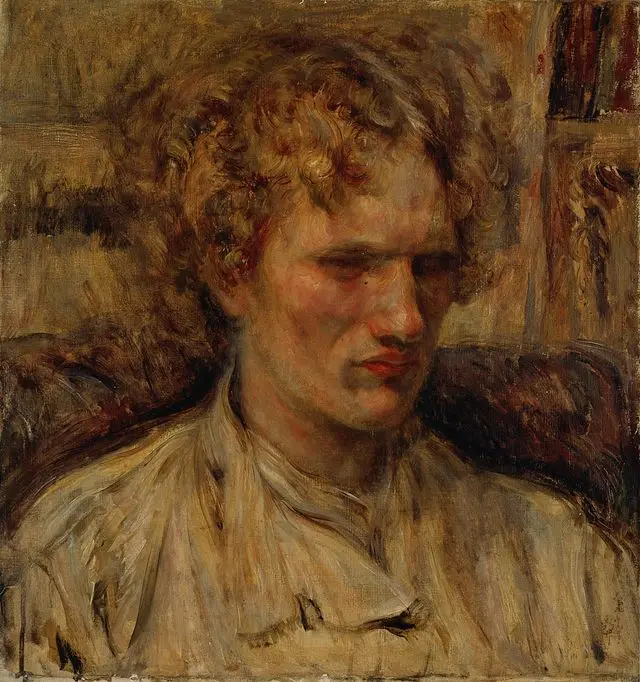
Portrait of Ivan Holubovskyi, 1905From the series of Holubovskyi family portraits that Novakivskyi painted over many years.
Landscape with a Boat, 1897The earliest work in this selection — Novakivskyi is twenty-five and still studying in Kraków.
Summer River LandscapeA river in summer light. Painted before 1935.
Ukrainian Madonna, 1919A Madonna in Ukrainian dress — an attempt to build a national sacred image rather than repeat the Byzantine canon.
Still Life, 1916Fruit and flowers in thick impasto — Novakivskyi liked his colour dense and heavy.
The Sacred Heart, 1913A sacred composition painted in the year he moved to Lviv — a religious subject handled in frankly modern, Secession terms.
Spring, 1930A late landscape in open colour — by now Novakivskyi had all but abandoned detail.
Portrait of the Artist's Wife, 1906A portrait of Anna Novakivska, the painter's constant model throughout his life.
Digging in the Garden, 1920Two women in white working a vegetable plot — a village subject taken without ethnographic sweetness.
In Thought, 1899An early work of the Kraków years, dated 5 November 1899.
At the Piano, 1905From the National Museum in Warsaw. An interior with two figures at the instrument — from Novakivskyi's early Kraków years.
Portrait of a Little Girl, 1882A child portrait from the Paris years, now held in Ostrava.
Lilacs, 1880A woman holding a branch of lilac — one of the softest works in colour that Bashkirtseff made.
Red-Haired Girl, c. 1882A head study with loose red hair — free painting, far from formal portraiture.
Oriental Woman, 1882An Orientalist study — a fashionable Paris genre of the 1880s that Bashkirtseff took up only once.
Georgette, 1881A Paris model in a white hat. Bashkirtseff painted women without salon idealisation — which set her apart from her contemporaries.
Caricature of Rodolphe Julian, c. 1878A caricature of the founder of the Académie Julian — one of the few Paris schools that admitted women. A rare comic piece in Bashkirtseff's work.
Girl Reading by a WaterfallA plein-air work of the Paris years, combining salon finish with live sunlight.
Portrait of Paul Bashkirtseff, 1876A portrait of the artist's brother, painted in Nice when Bashkirtseff was eighteen — before Paris and the Académie Julian. From the Musée des Beaux-Arts de Nice.
Colour Design, 1922An abstract colour design — the border between easel painting and the applied design Ekster turned to in Paris.
Still Life with Eggs, 1915Plain things — a dish, eggs, cloth — as a pretext for pure geometry and colour.
Venice, 1915Venice, where Ekster exhibited and mixed with the Italian Futurists.
Still Life, 1913A Cubo-Futurist still life — the genre in which Ekster moved fastest towards abstraction.
Paris Cityscape, 1912Paris as Ekster saw it at the start of her Cubist decade.
Cubist Nude, c. 1912From the MoMA collection. One of Ekster's earliest Cubist works, painted in Paris alongside the studios of Picasso and Braque.
The Boat and the Town, 1925A late Paris-period work: colour no longer tears form apart but builds it in large flat planes.
Theatrical Composition, c. 1925A Paris-period stage design. Sheets like this fed both Art Deco and 1920s film design.
The Music LessonFigures and instruments broken into rhythmic planes — music rendered as graphic structure.
Landscape with Houses and TreesA mid-1910s Cubist landscape, from the years the artist split between Paris and Kyiv.
Composition, 1918A non-objective work from the revolutionary years, when Ekster was decorating the streets of Kyiv and running her own studio.
Italian Town by the Sea, 1917From the Minneapolis Institute of Art. A Mediterranean town assembled from coloured wedges and arcs.
Colour DynamicsFrom the Kunsthaus Zürich collection. Ekster's central theme: colour as an independent force that generates movement.
Construction, 1922–1923A Constructivist composition: colour used as an engineering component rather than decoration.
Composition (Genoa)The port of Genoa as a Cubist construction — masts, facades and signage collapsed into a single plane.
"Thamyris Kitharodos". Maenad, 1916A maenad costume design for the Kamerny Theatre production of "Thamyris Kitharodos" — the work that made Ekster one of the most influential stage designers of her time.