Old wooden house with a balcony | Ukraine in color
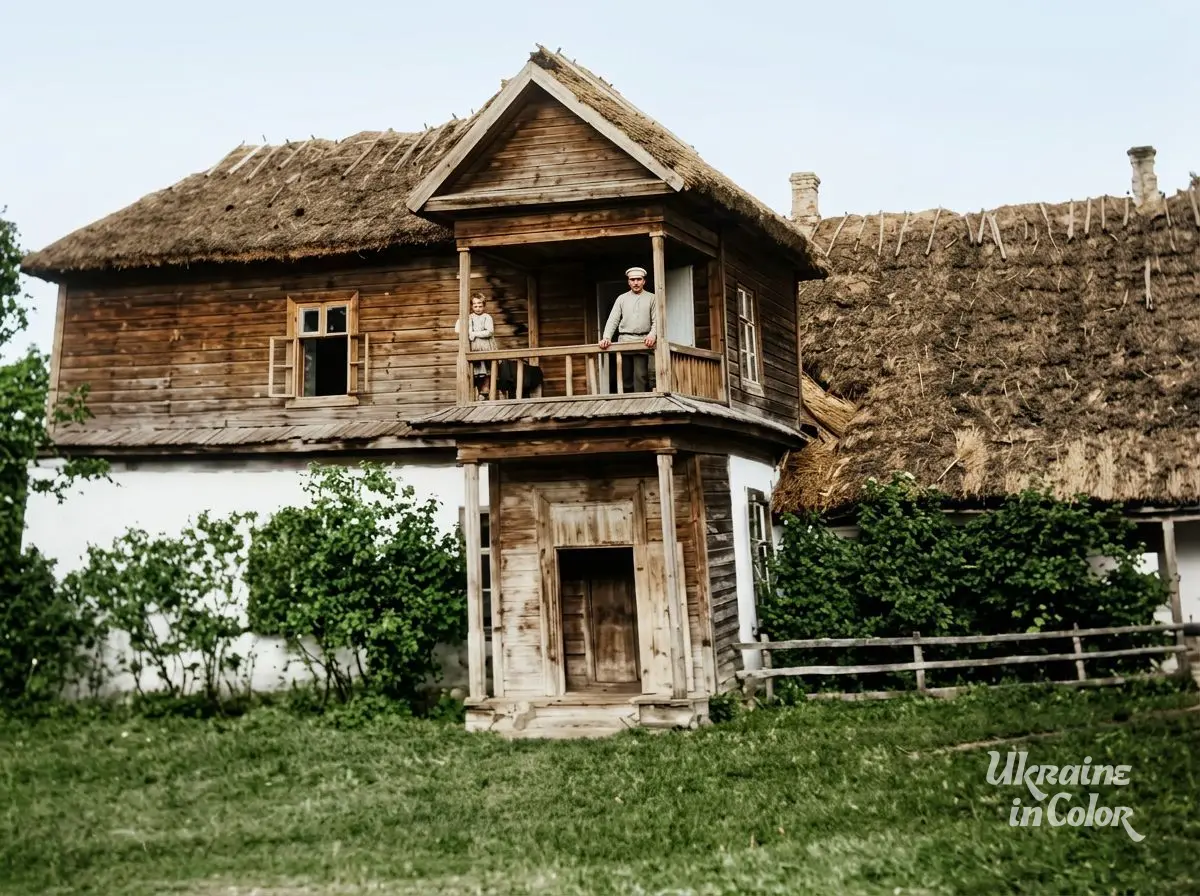
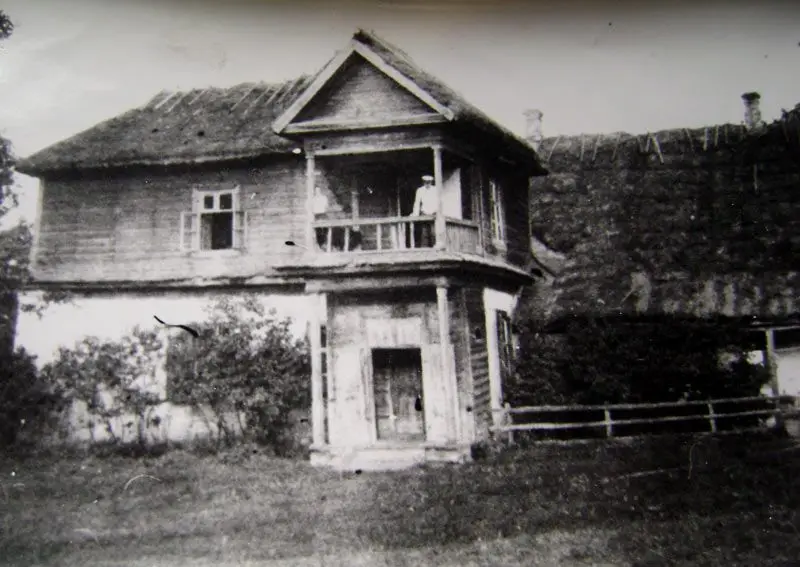
Old wooden house with a balcony
A wooden house with an attic floor and a balcony in a garden. From the Lindfors–Rusov family archive; probably one of the family estates. From the archive of the Sofiia Rusova Charitable Foundation.
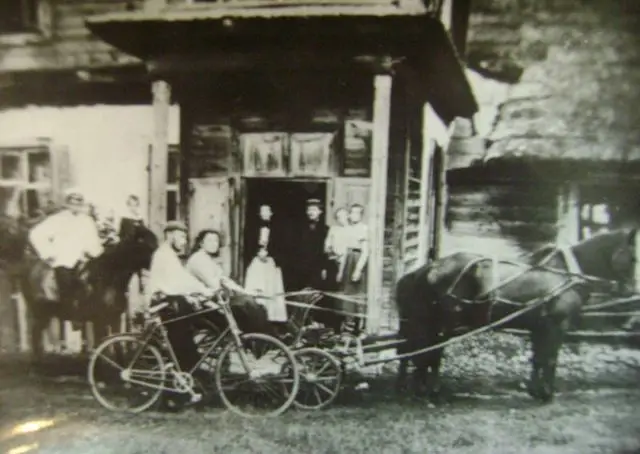
Family by a house with bicycles and horsesFamily and guests by a wooden house: bicycles, a horse and cart, children on the porch. From the Lindfors–Rusov family archive. From the archive of the Sofiia Rusova Charitable Foundation.
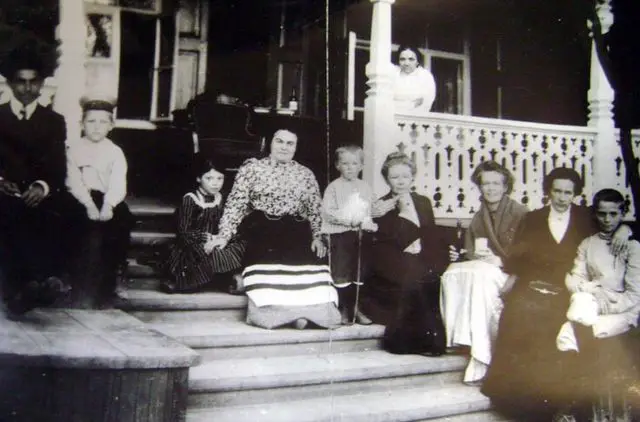
Family on the porch of a houseA large family sits on porch steps with carved railings. From the Lindfors–Rusov family archive, early 20th century. The people are not identified. From the archive of the Sofiia Rusova Charitable Foundation.
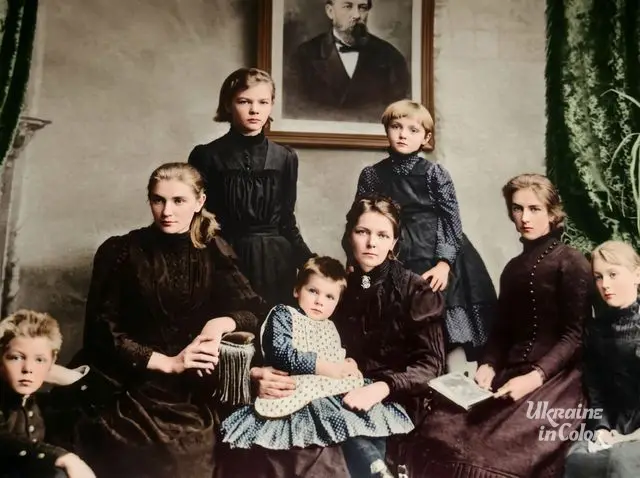
Family photo under a portraitWomen and children of the family sit below a large portrait of a bearded man. From the Lindfors–Rusov family archive, late 19th century. The people are not identified. From the archive of the Sofiia Rusova Charitable Foundation.
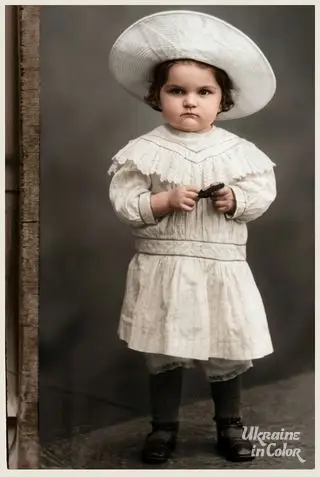
Nina Oleksandrivna Lindfors as a childLittle Nina Oleksandrivna Lindfors in a light dress and a wide hat. The Lindfors family, into which Sofiia Rusova was born. Early 20th century. From the archive of the Sofiia Rusova Charitable Foundation.
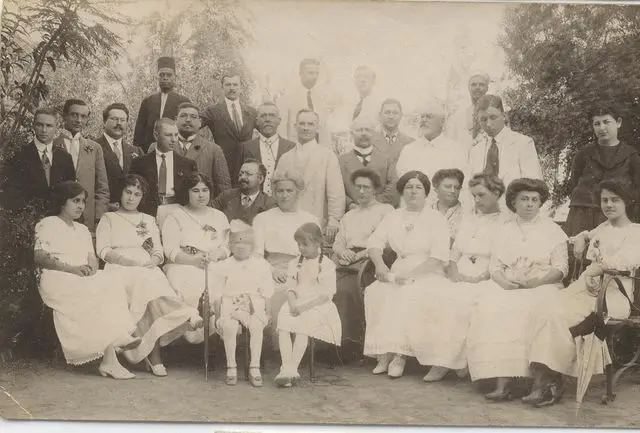
Group photo with Olha LindforsLarge group photo in a garden: women in white dresses seated in front, men standing behind. Among them is Olha Lindfors of Sofiia Rusova's family. Early 20th century. From the archive of the Sofiia Rusova Charitable Foundation.
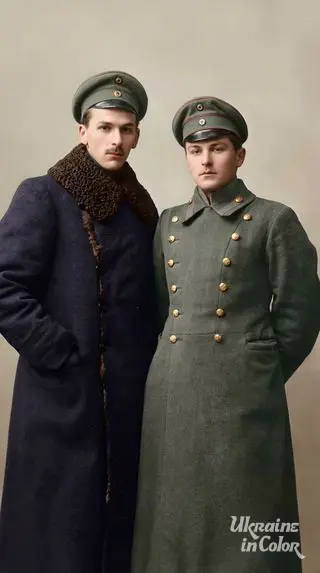
Mykola and Borys Kaminer in uniformTwo young men in greatcoats and caps — Mykola and Borys, sons of Olha Oleksandrivna (née Lindfors) and Borys Kaminer. Probably during the First World War. From the archive of the Sofiia Rusova Charitable Foundation.
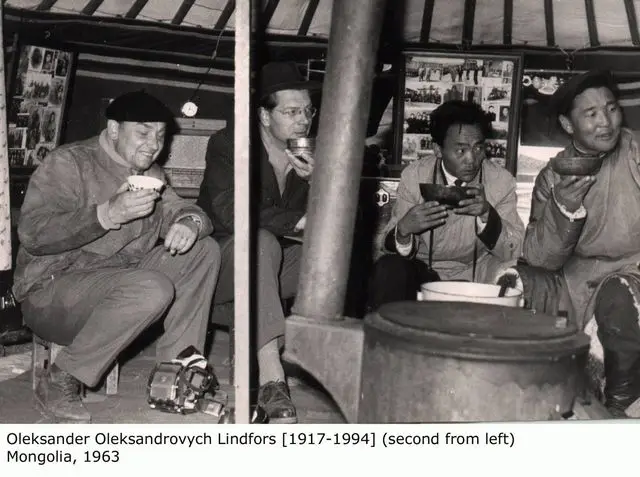
Oleksandr Oleksandrovych Lindfors in Mongolia, 1963Oleksandr Oleksandrovych Lindfors (1917–1994, second from left) with companions in a yurt. Mongolia, 1963. A member of the Lindfors family into which Sofiia Rusova was born. From the archive of the Sofiia Rusova Charitable Foundation.
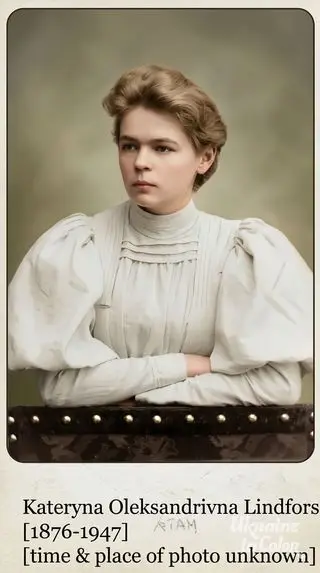
Kateryna Oleksandrivna LindforsStudio portrait of Kateryna Oleksandrivna Lindfors (1876–1947), of the Lindfors family into which Sofiia Rusova was born. Time and place unknown. From the archive of the Sofiia Rusova Charitable Foundation.
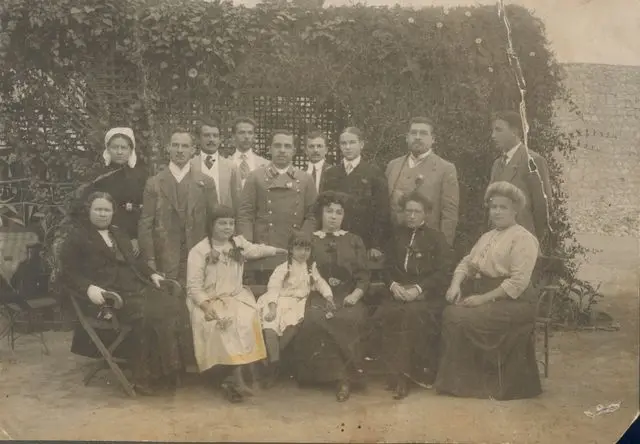
Group photo from Sofiia Rusova's circleGroup photo of men and women in a garden by an ivy-covered wall. Kept in the historical photo album of the Sofiia Rusova Charitable Foundation. Event, date and people are not established.
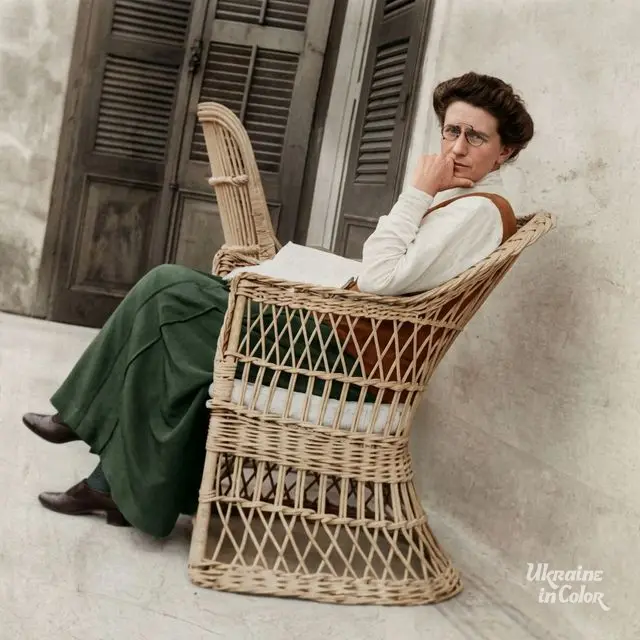
Sofiia Rusova in a wicker chairSofiia Rusova sits in a wicker chair next to a house with shutters. Photo from the archive of the Sofiia Rusova Charitable Foundation. Date and place are not established; probably the Prague period (1920s–1930s).
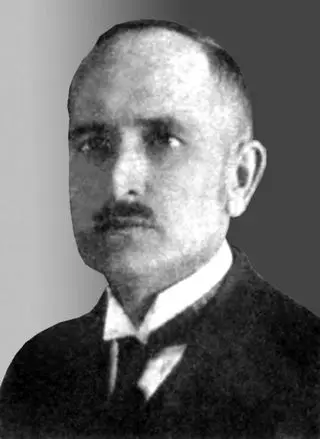
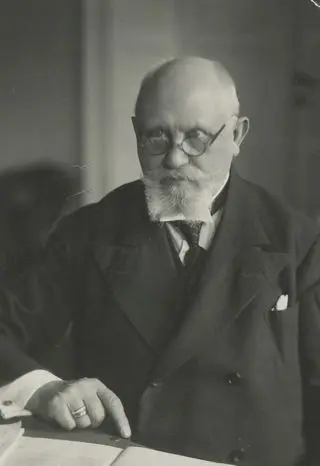
Ivan Zilynsky, portraitPortrait of the linguist and researcher of the Lemko dialects Ivan Zilynsky. After the Second World War he stayed in Prague as professor of Ukrainian and Belarusian at Charles University and died in Prague in 1952. The date of the photo is unknown. Source: Wikimedia Commons.
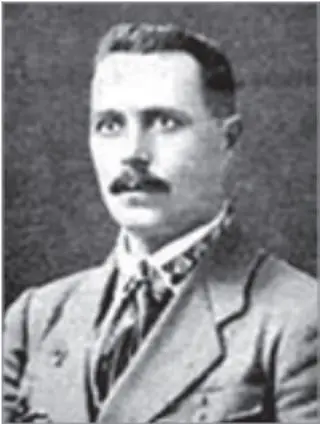
Fedir Steshko, 1920Portrait of the musicologist and UPR Army colonel Fedir Steshko, 1920. In 1922 Steshko moved to Prague in connection with the creation of the Ukrainian Free University and headed the chair of music history at the Drahomanov Institute. Source: Wikimedia Commons.
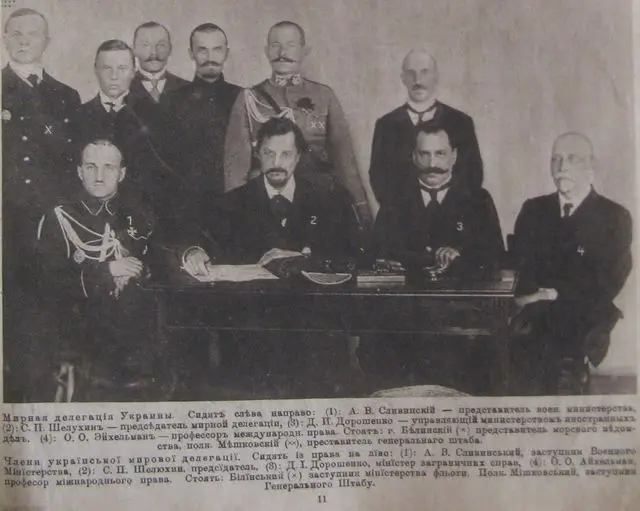
Ukrainian delegation at the peace talks with Soviet Russia, 1918The Ukrainian delegation at the peace talks with Soviet Russia, 1918. Seated (left to right): Slivinskyi, Shelukhin, Doroshenko, Eichelmann; standing: Bilinskyi and Mishkovskyi. Serhii Shelukhin headed the delegation; later he lived in Prague, and Otto Eichelmann taught at the Ukrainian Free University. Photo from Oko magazine; source: Wikimedia Commons.
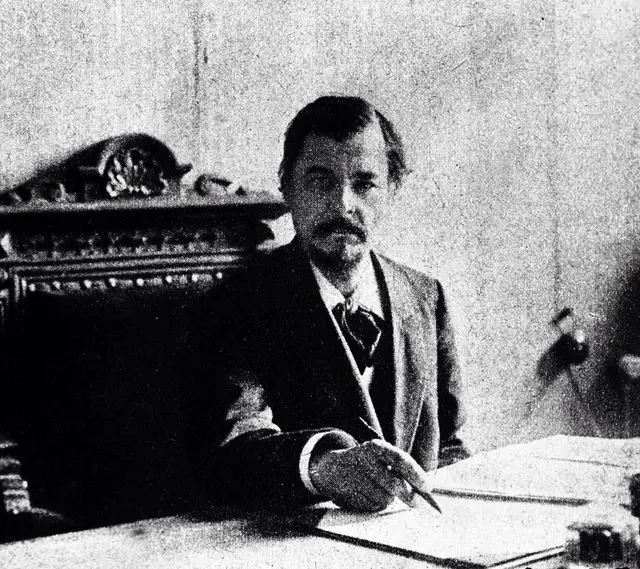
Serhii Shelukhin, 1918Portrait of the lawyer and diplomat Serhii Shelukhin, 1918, when he was Minister of Justice of the Ukrainian People's Republic and headed the Ukrainian delegation at the talks with Soviet Russia. In emigration Shelukhin lived in Prague, chaired the Ukrainian Committee in Czechoslovakia and died in Prague in 1938. Source: Wikimedia Commons.
Oleksandr Kolessa, 1937Portrait of the literary scholar and linguist Oleksandr Kolessa, 24 May 1937. Kolessa lived in Prague from 1921; as the first rector of the Ukrainian Free University in Prague he opened it with an inaugural lecture on 23 October 1921. Source: Wikimedia Commons.
Oksana LiaturynskaPortrait of the poet and sculptor Oksana Liaturynska. From 1924 she lived in Prague, studied at the Ukrainian Studio of Plastic Arts, and her collections Husla (1938) and Kniazha emal (1941) appeared there. The exact date of the photograph is unknown. Source: Wikimedia Commons.
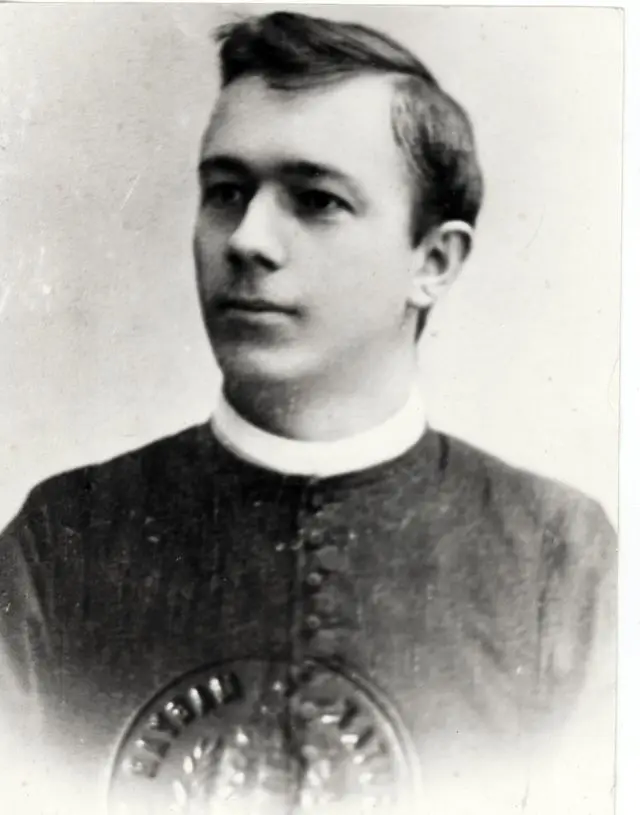
Avhustyn Voloshyn, portraitPortrait of Avhustyn Voloshyn, a Greek Catholic priest, prime minister of the autonomous government and president of Carpatho-Ukraine. After the Hungarian occupation of 1939 he lived in Prague and worked at the Ukrainian Free University; in May 1945 he was arrested in Prague. The date of the photo is unknown. Source: Wikimedia Commons.
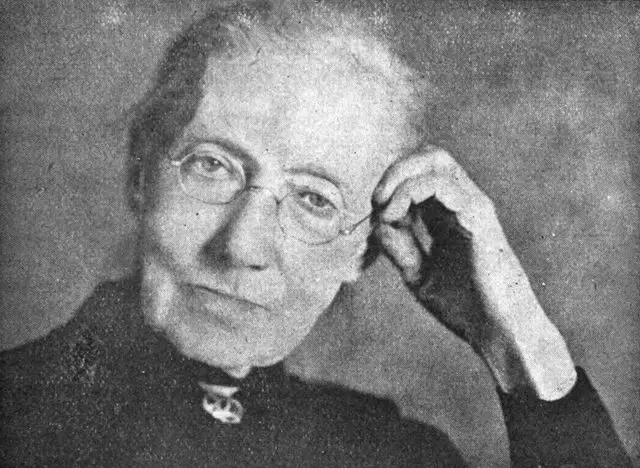
Sofiia Rusova, 1934Sofiia Rusova in 1934, during her Prague years. From 1923 she lived in Prague, taught pedagogy at the Drahomanov Institute and headed the National Council of Ukrainian Women. Source: Wikimedia Commons.
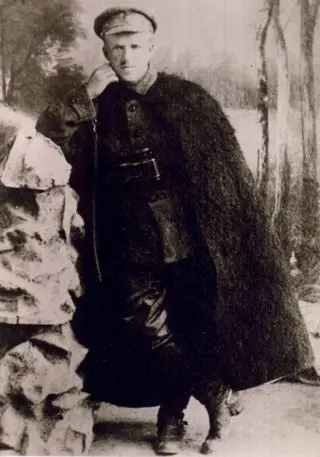
General Yurii Tiutiunnyk, 1920General Yurii Tiutiunnyk, 1920. In November 1921 he commanded the UNR Insurgent Army in the Second Winter Campaign. Source: Wikimedia Commons.
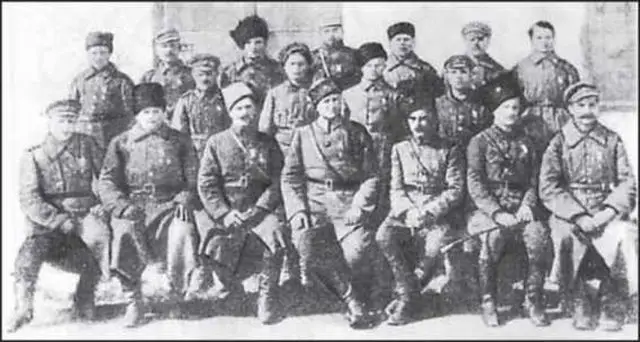
Second Winter Campaign participants in Kalisz, 1921A group of Second Winter Campaign participants in the internment camp for UNR Army soldiers in Kalisz in autumn 1921, before they left for Ukraine. Source: Wikimedia Commons.
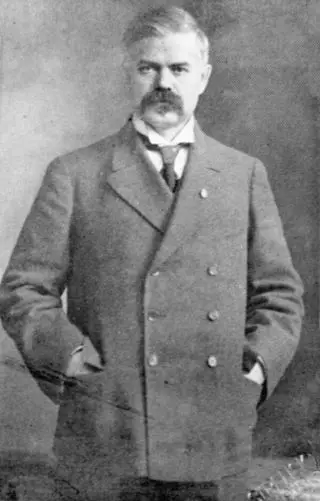
Mykyta Shapoval, 1920sPortrait of Mykyta Shapoval, a member of the Central Rada and a leader of the Ukrainian emigration in Czechoslovakia. The photo is dated to the 1920s, when Shapoval headed the Ukrainian Civic Committee in Prague, which founded the Ukrainian Husbandry Academy in Poděbrady. Source: Wikimedia Commons.
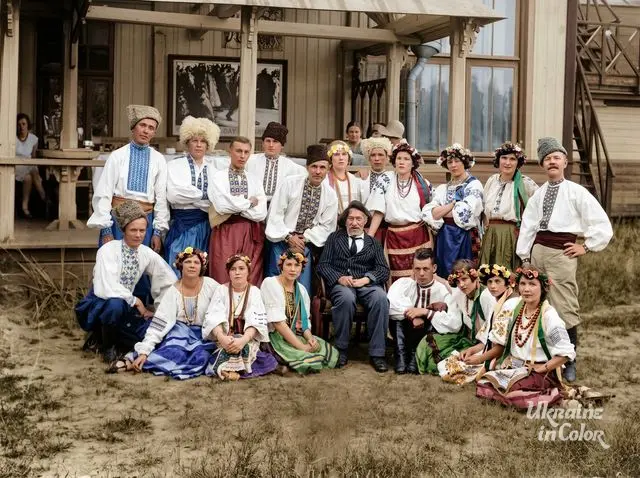
Ilya Repin with a choir that performed for him outside his villa Penaty in KuokkalaArchival photograph, 1929: Ilya Repin together with a folk-costumed choir that performed for him in front of his Penaty villa in Kuokkala. From the Finnish National Gallery (archive collections); photographer unknown; public domain.
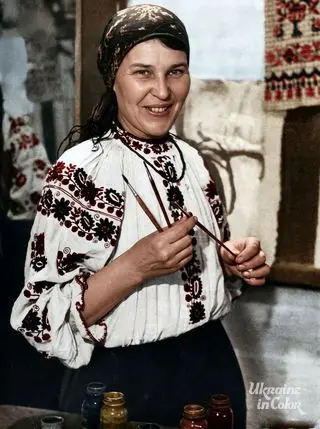
Maria Prymachenko at work in a vyshyvankaBlack-and-white portrait of Maria Prymachenko at work in her studio. The artist wears a dark headscarf and an embroidered blouse with dense floral ornament across the chest and sleeves, holding paintbrushes in her right hand. Jars of paint sit on the table in front of her. In the background are floral wall paintings inside her home-studio in Bolotnia village, Kyiv region. Probably 1940s–1950s.
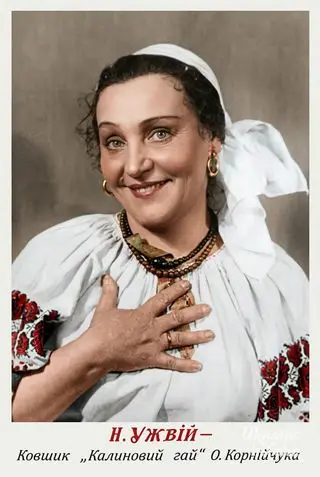
Natalia Uzhviy in the role of Kovshyk in 'Kalynovyi Hai' by O. KorniychukTheatrical studio photograph of Natalia Uzhviy in the role of Kovshyk in Oleksandr Korniychuk's play 'Kalynovyi Hai': in a white embroidered shirt with a plant pattern, with a beaded necklace and round earrings, a white headscarf tied behind her head. She smiles with her hands folded on her chest. Below is a printed caption: 'N. UZHVIY — Kovshyk "Kalynovyi Hai" by O. Korniychuk'. Taken during her active years at the Kyiv Ivan Franko Theatre.
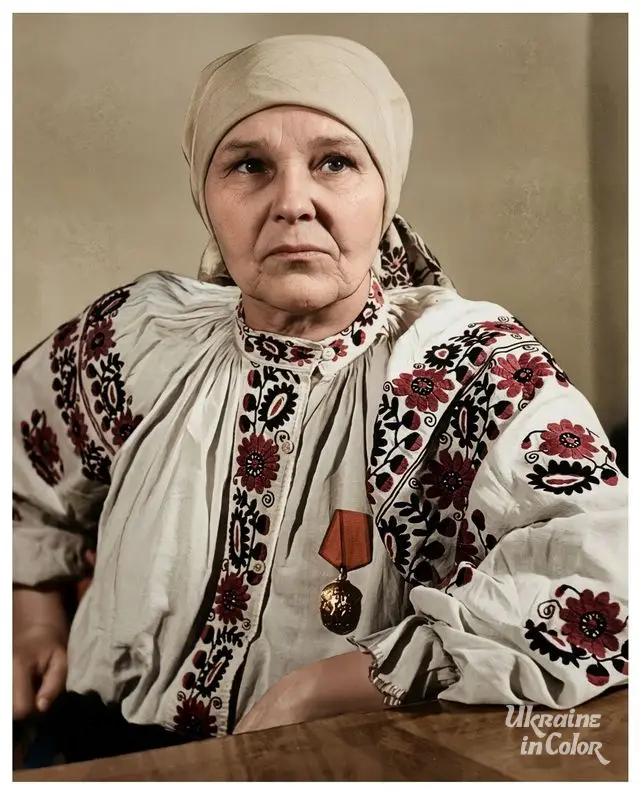
Maria Prymachenko — portrait with a medal in a vyshyvankaHalf-length portrait of an elderly Maria Prymachenko: in a white headscarf tied under the chin and an embroidered shirt with a rich plant pattern — sunflowers and winding stems across the chest and sleeves. On her chest is a medal on a ribbon, most likely the Shevchenko Prize award or the Honoured Art Worker of the Ukrainian SSR. She sits with her forearm resting on a table.
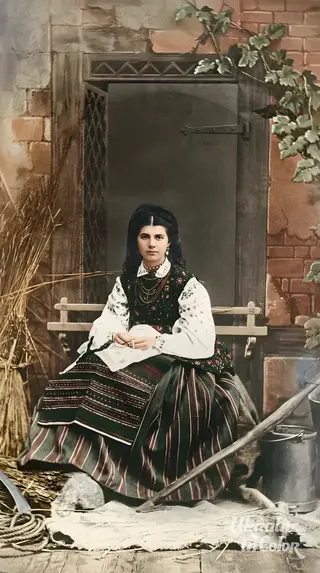
Olena Pchilka in her youth — studio portraitStudio half-length portrait of young Olena Pchilka (Olha Drahomanova-Kosach): in a white embroidered shirt with an openwork pattern and a dark waistcoat with a small floral ornament, with several strands of beaded necklaces around her neck. She is shown in three-quarter pose, with one hand holding a flower and resting on a stone plinth. The background is a studio backdrop.
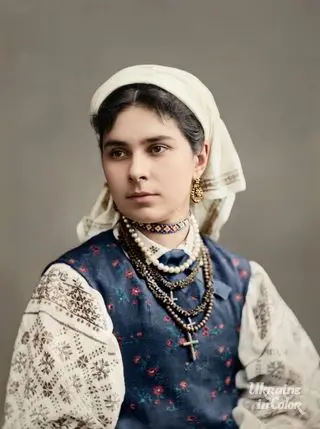
Liudmyla Drahomanova in a headscarf and beaded necklacesStudio portrait of young Liudmyla Drahomanova: in a white headscarf tied in the classical Ukrainian manner, an embroidered shirt with an openwork pattern on the sleeves and a dark waistcoat with a small floral pattern. Around her neck are several strands of beaded necklaces, among them dukachi (coin pendants) and a small cross. A pendant earring hangs from her ear.
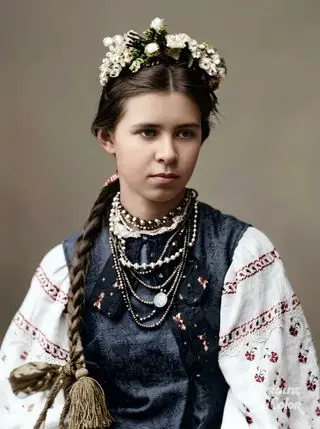
Lesya Ukrainka in a floral wreathStudio portrait of young Lesya Ukrainka in a wreath of wildflowers with a dark ribbon, with a long braid over her shoulder, wearing an embroidered shirt and a dark bodice, with several strands of beaded necklaces. One of the canonical photographs of the poet in Ukrainian folk dress from her early creative period.
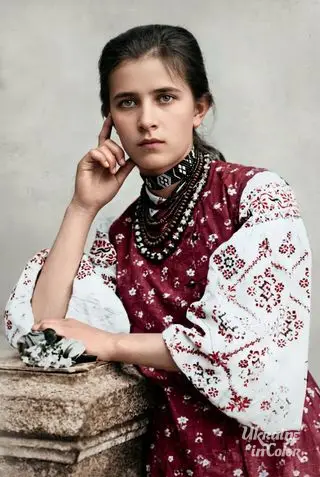
Lesya Ukrainka in her youth with flowersStudio portrait of young Lesya Ukrainka: in a dark embroidered blouse with a dense floral pattern and wide white sleeves with geometric openwork embroidery, wearing a beaded necklace and an embroidered ribbon at the throat. She leans her left arm on a studio pedestal where a bouquet of wildflowers rests. One of the best-known photographs of the poet as a young woman.
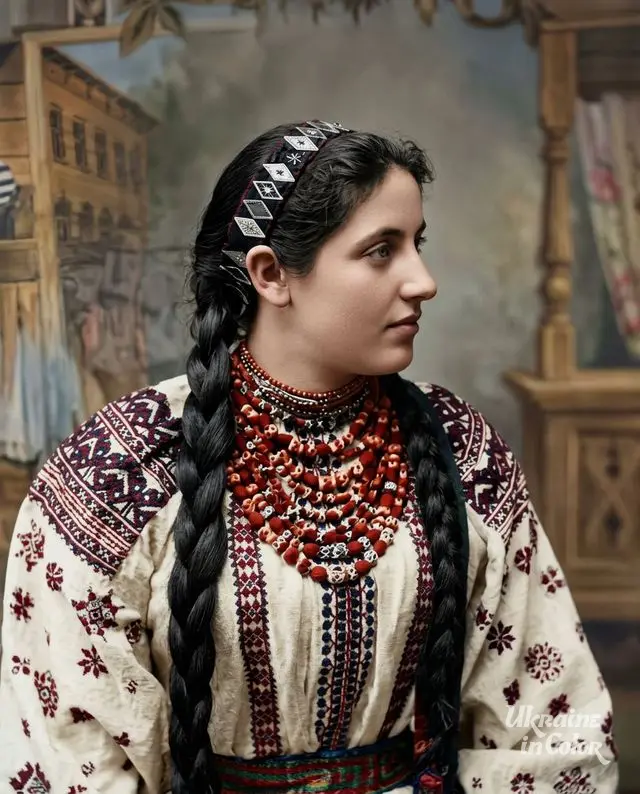
Solomiya Krushelnytska — profile with braid in a vyshyvankaSepia profile portrait of Solomiya Krushelnytska: a long braid thrown over her shoulder, an embroidered band with a geometric pattern on her head, an embroidered shirt with dense ornament across the chest, and a beaded necklace. The silhouette of a building is visible in the background. A photograph from the early period of her career.
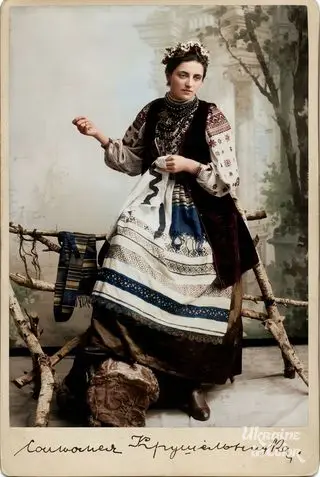
Solomiya Krushelnytska — signed full-length portraitFull-length studio portrait of the opera singer Solomiya Krushelnytska in elaborate Ukrainian dress: an embroidered shirt with a geometric pattern, a dark waistcoat, a festive ornamented apron, a floral wreath and beaded necklace. She stands beside a wooden fence in a studio setting. At the bottom is her handwritten signature 'Solomeya Krushelnytska'.
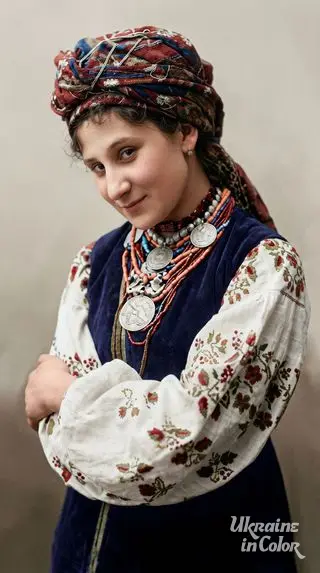
Maria Zankovetska — cabinet portrait in a vyshyvankaStudio cabinet portrait of the actress Maria Zankovetska: in an embroidered blouse with billowing sleeves, a dark waistcoat, a floral headdress and a beaded necklace, with a slight smile and her face turned toward the viewer. A photograph from the years of her active stage career with the Ukrainian travelling troupes.
Kateryna Bilokur — half-length portrait in a vyshyvankaHalf-length profile portrait of Kateryna Bilokur in a white embroidered blouse with an openwork pattern and a dark waistcoat, with a beaded necklace, against the greenery of her garden. A mid-life photograph.
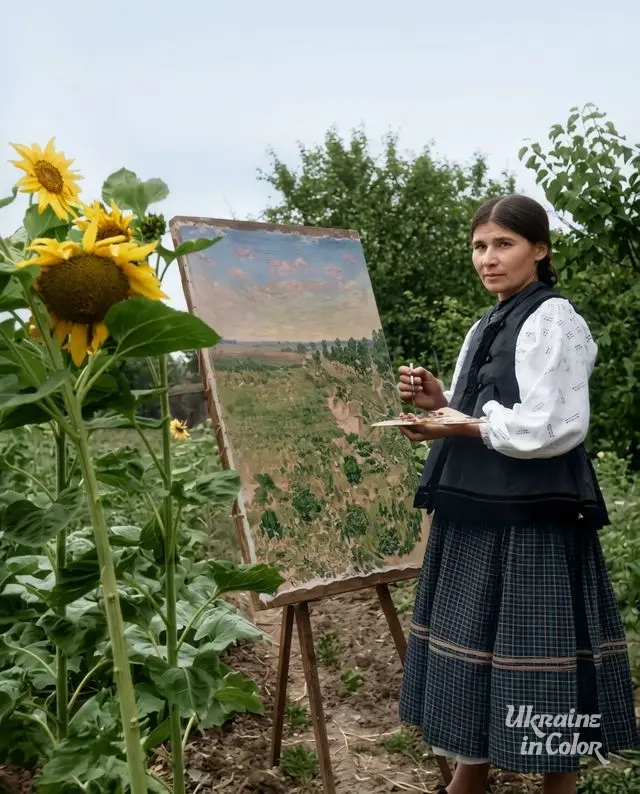
Kateryna Bilokur at her easel in the gardenKateryna Bilokur paints a floral still life with sunflowers at her easel amid her garden in Bohdanivka. The artist wears a dark waistcoat over an embroidered blouse and a checked skirt. One of the most recognizable photographs of her working in her natural setting.
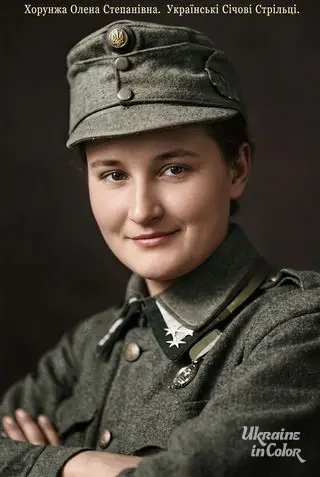
Postcard portrait: 'Khorunzha Olena Stepanivna. Ukrainian Sich Riflemen', c. 1915A sepia-toned patriotic postcard portrait of Olena Stepaniv from the First World War period. The upper portion bears a printed Ukrainian inscription: 'Khorunzha Olena Stepanivna. Ukrainian Sich Riflemen.' She is shown in USS uniform: a mazepynka cap with cockade, a tunic with embroidered collar; on her chest are her decorations: on her left (the viewer's left) — the silver Austro-Hungarian Medal for Bravery awarded on 10 November 1914 for her role in the Carpathian Campaign; on her right — the insignia of the Ukrainian Sich Riflemen. Likely published in Lviv c. 1915 for patriotic distribution. The original is held by the Museum of Military History (Heeresgeschichtliches Museum) in Vienna, inv. no. 2010_42_738_104.
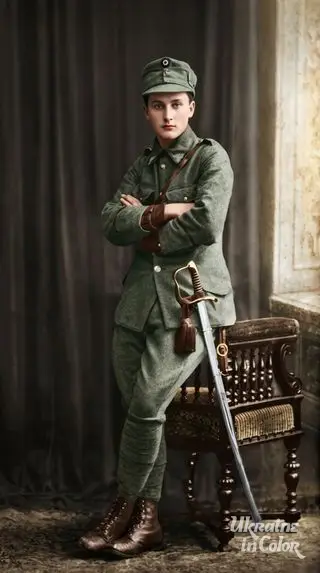
Studio portrait of Olena Stepaniv with saber and decoration on her sleeve, in USS uniform, c. 1914–1915Full-length studio portrait of Olena Stepaniv in the uniform of the Ukrainian Sich Riflemen: a mazepynka cap with cockade, a tunic with breast pocket, breeches with puttees, and high lace-up boots. She stands with arms crossed on her chest, her right hand resting on an officer's saber stood vertically on the floor. A decoration ribbon is visible on her left sleeve — likely the silver Austro-Hungarian Medal for Bravery she was awarded on 10 November 1914 for her role in the Carpathian Campaign. The backdrop is a studio curtain on the right and a wicker chair on the left. A photographer's stamp is visible in the lower-right corner.
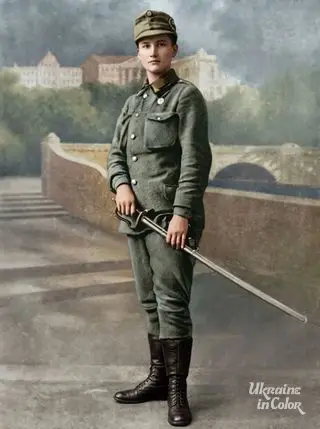
Full-length studio portrait of Olena Stepaniv with a saber, in USS uniform, c. 1914–1915Full-length studio portrait of Olena Stepaniv in the uniform of the Ukrainian Sich Riflemen: a mazepynka cap with cockade, a tunic with breast pocket, breeches with puttees and boots. In her right hand is an officer's saber. The backdrop is a painted studio scene with a balustrade and park architecture. Likely taken in Lviv in 1914–1915, during her active service with the USS before her capture by Russian forces in May 1915.
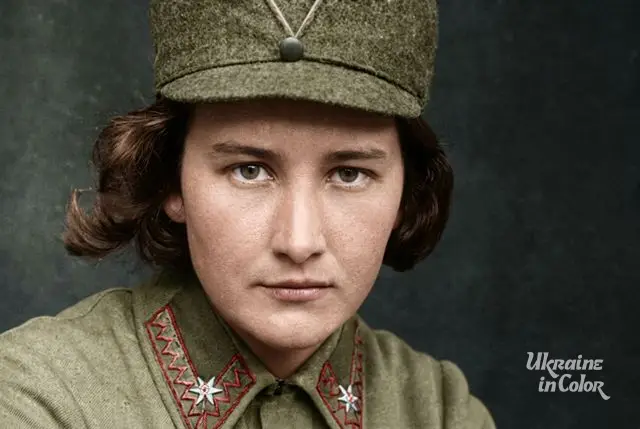
Studio portrait of USS officer (khorunzha) Olena Stepaniv, c. 1914–1915Studio portrait of Olena Stepaniv in the uniform of a khorunzha (junior officer) of the Ukrainian Sich Riflemen (USS). The eight-pointed star insignia on the collar tabs marks USS officer rank; the mazepynka cap bears a central cockade. The tunic collar is decorated with traditional Ukrainian embroidery. The photograph was likely taken in Lviv during her period of active service (1914–1915), before her capture by Russian forces near Bolekhov in May 1915.
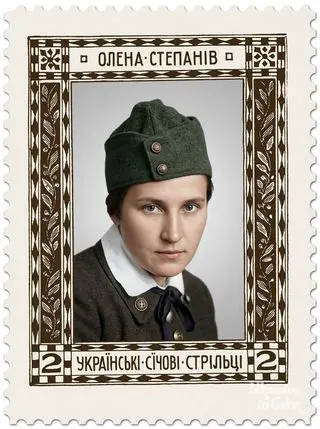
Postage stamp featuring Olena StepanivPostage stamp featuring Olena Stepaniv — part of a series dedicated to prominent Ukrainian women and figures of the Ukrainian Sich Riflemen.
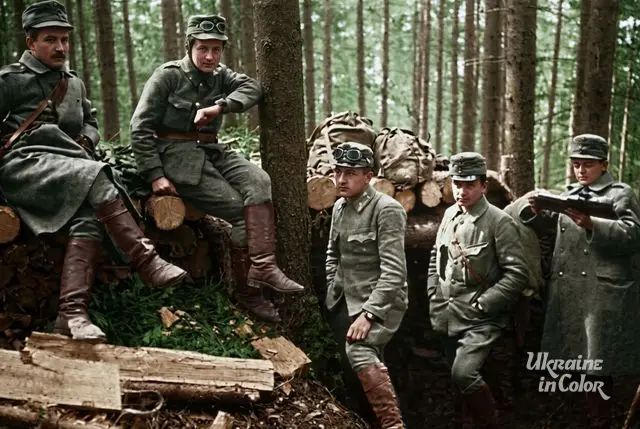
USS Officers on Mount Makivka: Zenon Noskovskyi, Olena Stepaniv, Ivan Chmola, Osyp Yarymovych, Sofia HalechkoOfficers of the Ukrainian Sich Riflemen on Mount Makivka: Zenon Noskovskyi, Olena Stepaniv, Ivan Chmola, Osyp Yarymovych, and Sofia Halechko. Mount Makivka (Skole Beskids, Carpathians) was the site of the USS battle against Russian forces in April–May 1915, in which Olena Stepaniv participated and for which she received the silver Medal for Bravery.