Igor Sikorsky, 1940 flting the VS-300A | Ukraine in color
Igor Sikorsky, 1940 flting the VS-300A
Original: All rights reservedRestoration: All rights reserved
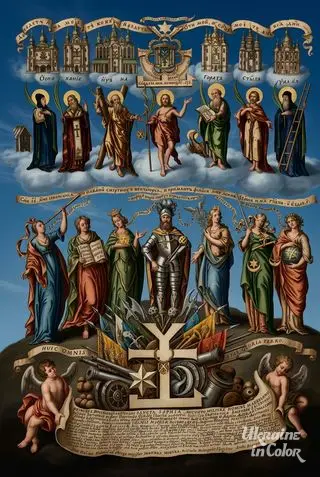
Ivan Mazepa Among His Good DeedsA panegyric thesis engraving dedicated to Hetman Ivan Mazepa by Ivan Myhura, archdeacon of the St Sophia monastery in Kyiv. The sheet is built in three registers. Above, on clouds, stand the Kyiv churches built and restored at the hetman's expense, with a seven-columned rotunda between them as an image of Wisdom and the seven liberal arts; below them a row of saints. In the middle register Mazepa appears in knightly armour holding the hetman's mace, surrounded by female personifications of the virtues and the sciences; one of them holds an open book bearing his name. At the foot two putti lean on military trophies — a cannon, drums, arms and banners — flanking the Kurcz coat of arms and the mottoes HUIC OMNIS and STAT GLORIA FERRO. The Latin dedication in the cartouche opens "PRINCEPS ECCLESIARVM TRIVMPHANS SANCTA SOPHIA…", styles Mazepa a knight of the Orders of St Andrew and the White Eagle, and is dated "Kijov 8br 12" — Kyiv, 12 October. Myhura signed himself "IOANNES MIGVRA, Orientalis Metropolis Kijoviensis Archi-Diaconus". The sheet is usually dated 1706, though some scholars tie it to Mazepa's visit to Kyiv on 12 October 1705. After the anathema of 1708 images of the hetman were destroyed on Peter I's orders — this engraving is one of the few made in his lifetime to survive.
Portrait of a woman wearing a ringA black-and-white studio portrait: a young woman with short dark hair rests her chin on her folded hands, wearing a light tweed jacket. On her finger is a massive ring with a dark stone — the real subject of the photograph. A crease survives across the upper left of the print.
The sitter is not identified: the publication the image comes from carries no caption. By context she is a client or a model of the house of Marchak.
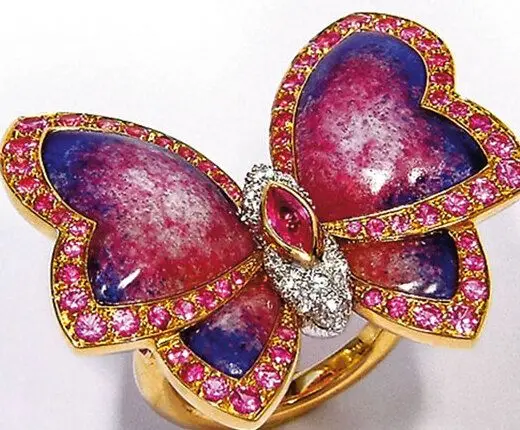
Butterfly ring with heart-shaped wingsA ring crowned by a butterfly with four heart-shaped wings. Each wing is a plaque of stone shading deeply from blue-violet to crimson, outlined with pink sapphires. The body is pavé-set with diamonds and the head is a red stone in a gold mount. Maison Marchak, Paris.
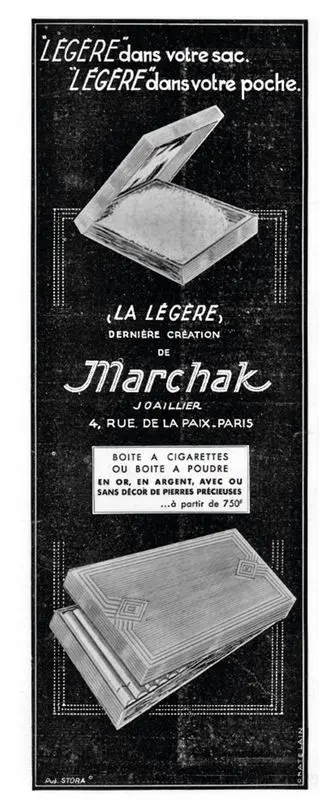
Advertisement for the "La Légère" cigarette caseA vertical advertisement, white on black. At the top runs the slogan "LÉGÈRE dans votre sac, LÉGÈRE dans votre poche" ("light in your bag, light in your pocket") above an image of an open flat case. Below stand "'LA LEGERE', dernière création de Marchak, joaillier, 4, Rue de la Paix, Paris" and a line offering "a cigarette box or powder compact in gold or silver, with or without precious stones — from 750 francs". Two closed cases with Art Deco engine-turning appear at the foot.
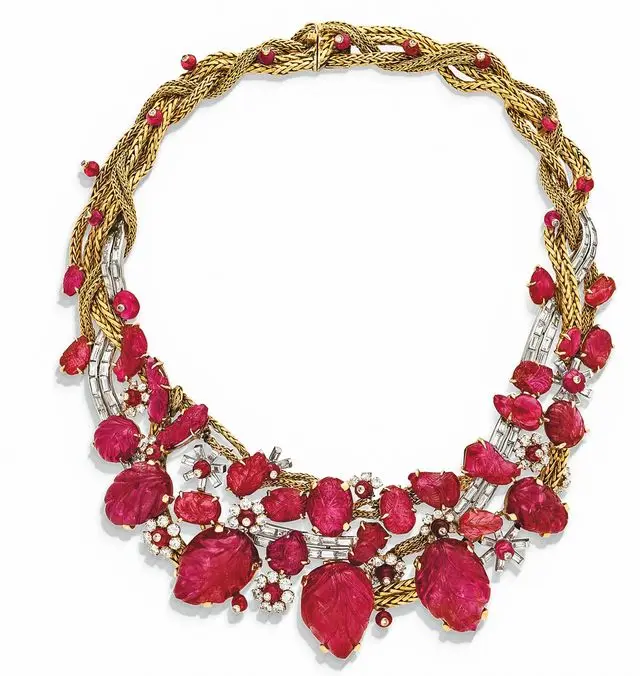
Bib necklace with carved rubiesA massive bib necklace. The foundation is several twisted ropes of yellow gold, with white diamond-set links breaking through between them. Large carved rubies in the form of leaves and fruit are clustered across these, together with round ruby beads; the biggest stones gather at the bottom where the necklace is widest. Maison Marchak, Paris, about 1955.
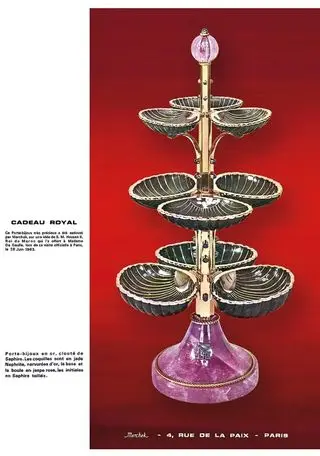
"Cadeau Royal" — a jewel stand for the King of MoroccoA three-tier jewel stand on a central gold shaft, photographed against red. Each tier is made up of several shell-shaped bowls of dark stone in gold mounts; the base and the finial are of pale lilac stone banded with gold hoops.
The caption on the card explains that this was the gift presented by King Hassan II of Morocco during his official visit to Paris on 28 June 1963. The signature at the foot reads "Marchak — 4, Rue de la Paix — Paris".
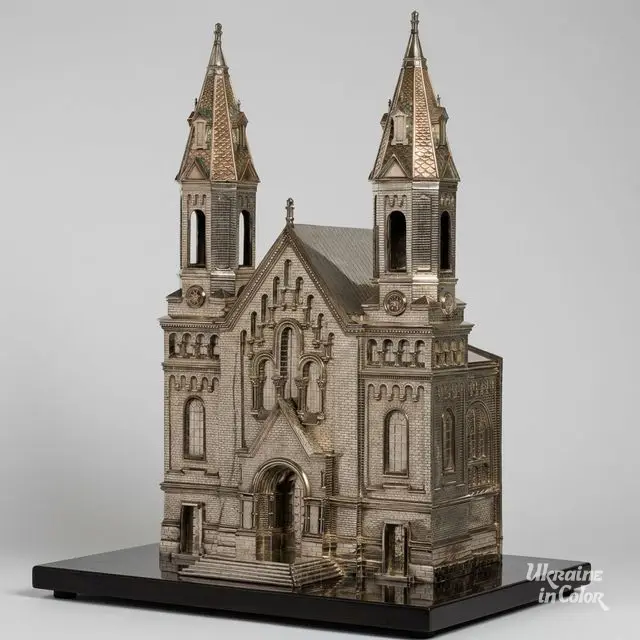
Model of a twin-towered churchAn architectural model of a neo-Gothic church on a dark plinth: two tall spired towers, a pointed portal, a rose window above the entrance and buttresses along the sides. Individual windows, cornices and the coursing of the walls are all reproduced.
Another example of the speciality that set the factory apart — exact architectural models of real buildings made as presentation pieces.
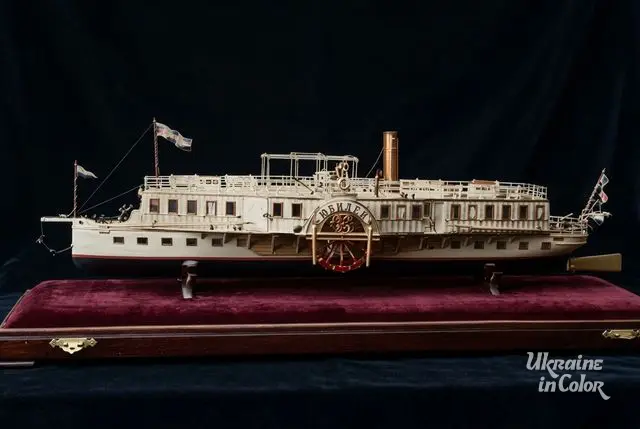
Mechanical model of a steamshipA detailed model of a paddle steamer on a rectangular base: a two-tier superstructure with rows of windows, a funnel, a paddle wheel with its housing, gangways, railings, boats and flags at the masts.
Among the factory's presentation pieces the public was especially struck by the mechanical model of the steamer Derzhava, ranked alongside the silver model of the Pedagogical Museum. This photograph is the only known image of such a work.
Benches at the windows: the fine-work shopA workshop with the benches pushed right up to the windows — the way daylight was captured for close work. The craftsmen sit in two rows with their backs to the aisle, bent over their bench pins; in the foreground stands an empty place with a lamp and the wooden skirting that caught the gold dust.
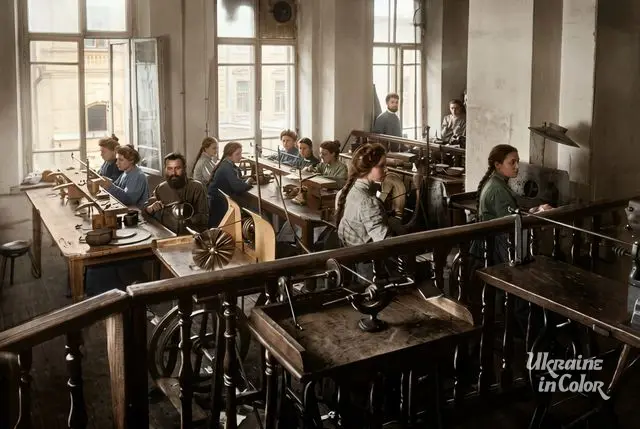
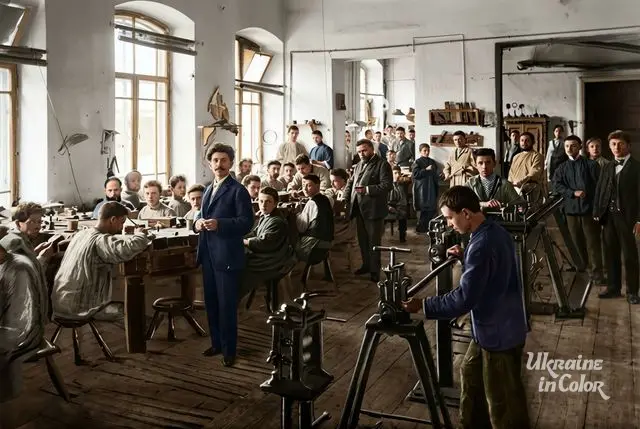
The factory's large production hallA long, well-lit hall with tall windows along both walls. Some twenty masters and journeymen work at long benches — some seated, others standing at belt-driven machines in the foreground. Tools and blanks fill the shelves along the walls. The largest known image of the factory's production floor.
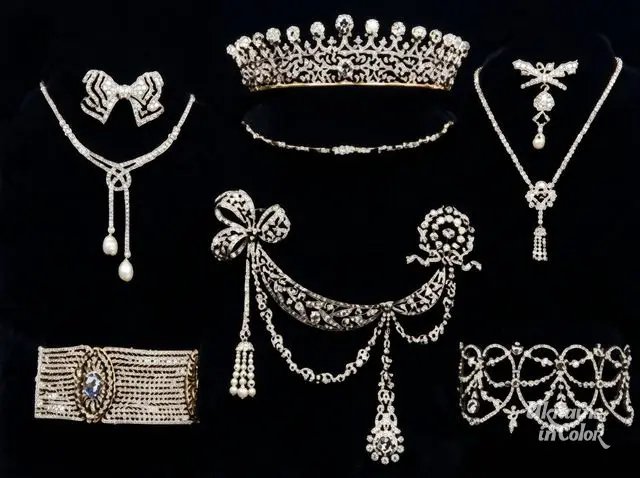
Plate of diamond jewels from the firm's illustrated price listA page from the illustrated price list: eight diamond pieces laid out against black. At the centre of the top row is a tiara with alternating tall and low points, and beneath it a slender bandeau. To the left are a bow brooch with two loops and a necklace with a drop pendant; to the right an insect brooch and a necklace with a long tassel. In the middle sits a large devant-de-corsage with a bow at the top, swags and three pendants, and along the bottom row two bracelets: a wide mesh band with an oval medallion and an openwork one of garlands and drops.
This is one of the few surviving images of the Kyiv factory's jewellery proper: the pieces themselves went to the melting pot after 1917, and today they are judged largely from printed sheets like this one.
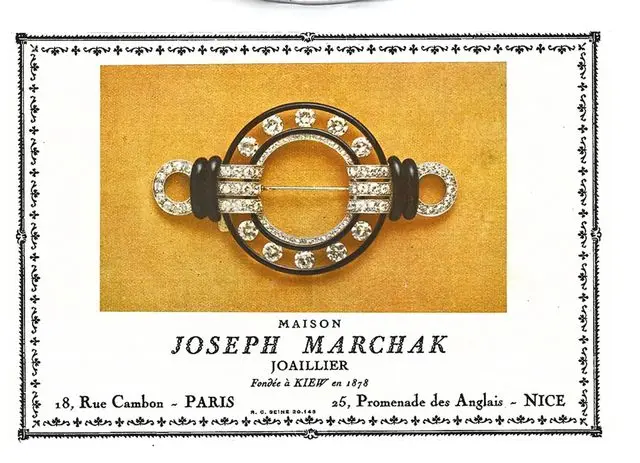
Advertising card "Maison Joseph Marchak"A card in an ornamental border. At the top, against an ochre ground, is a clasp or buckle with a central ring and black appliqués, entirely paved with diamonds. Below stand "MAISON JOSEPH MARCHAK, JOAILLIER, founded in Kyiv in 1878" and two addresses: "18, Rue Cambon — PARIS" and "25, Promenade des Anglais — NICE". The house went on printing that line about its Kyiv founding on French cards for decades after the factory was lost.
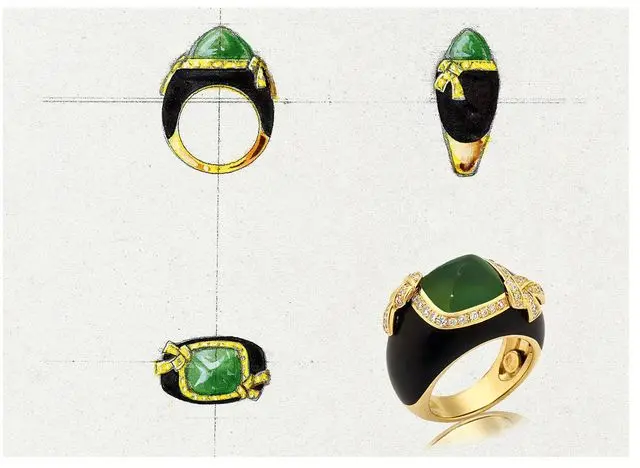
Working sheet with four views of a ringA drafted sheet showing four views of the same ring: profile, from above, in plan and in three-quarter perspective. The ring is black enamel with a green cabochon and gold bows at the sides. A fine axis line is ruled across the middle of the sheet — the trace of draughtsmanship rather than of painting.
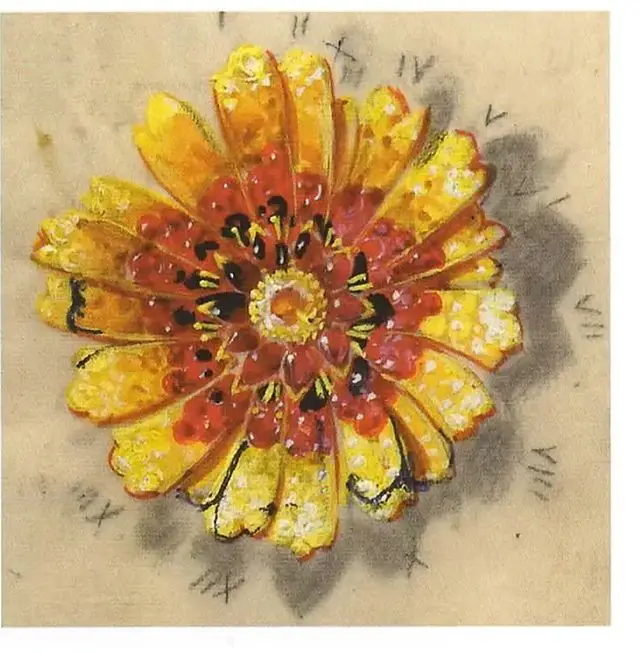
Design for a sunflower broochA gouache design for a sunflower brooch: two crowns of elongated yellow petals around a dense centre of small stones. Pencil guides and Roman numerals — the designer's working notes — are visible at the edges of the sheet. The sunflower is a recurring motif of the house, one the firm itself tied to its Kyiv origins.
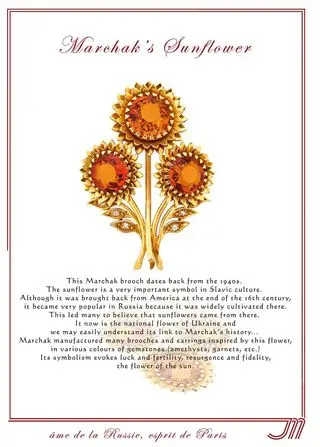
"Marchak's Sunflower" — the brooch and the firm's cardA firm's card in a thin red frame headed "Marchak's Sunflower". At its centre is a gold brooch of three sunflowers with large orange stones at their hearts, on diamond-set stems.
The English text on the card dates the brooch to the 1940s and explains the choice of motif: the sunflower "now is the national flower of Ukraine", and through that comes "its link to Marchak's history". The firm made many brooches and earrings with this flower — in amethysts, garnets and other stones — reading it as a symbol of luck, fertility, resurgence and fidelity. At the foot stands the house motto: "âme de la Russie, esprit de Paris".
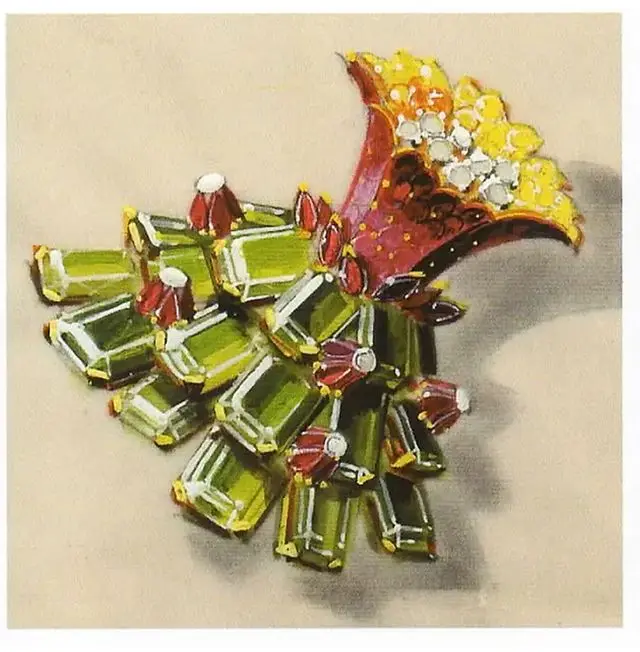
Design for a brooch with baguettes and a horn of fireA gouache design for a brooch: a cluster of green baguette-cut stones laid in rows, over which unfurls a red and yellow horn edged with diamond points. A grey shadow is left behind the piece to convey its volume.
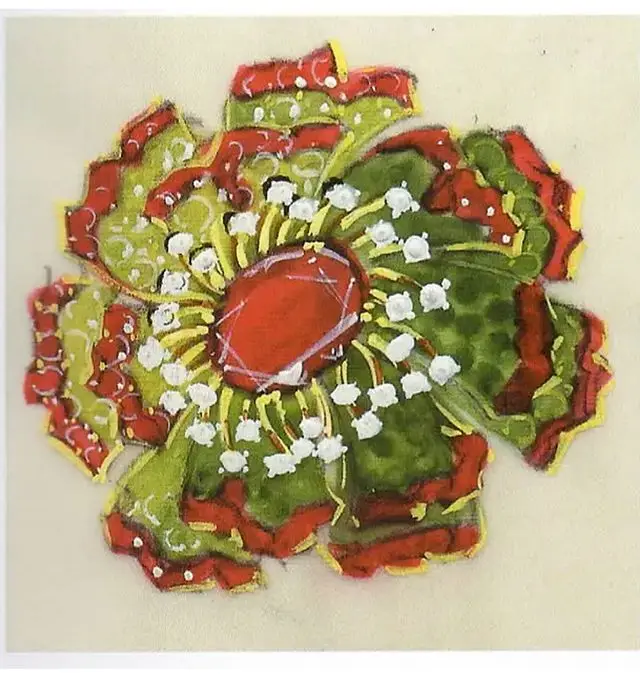
Design for a large flower broochA large gouache design for a brooch in the form of an open flower: a central orange stone ringed by two crowns of petals, green and red, with white stones scattered between them. Pencil underdrawing remains visible beneath the paint.
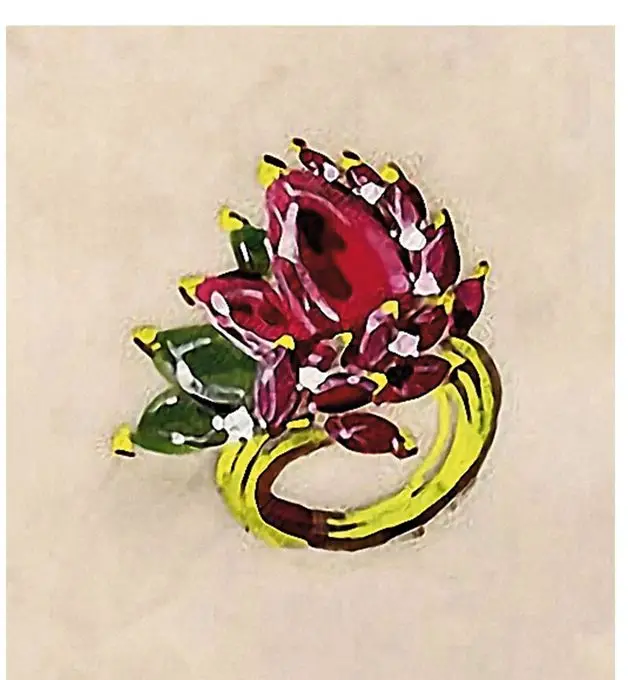
Design for a brooch with a ruby tulipA gouache design for a brooch: a bud made up of red marquises with black outlining, with two green leaves and a broad yellow ribbon curling beneath the flower.
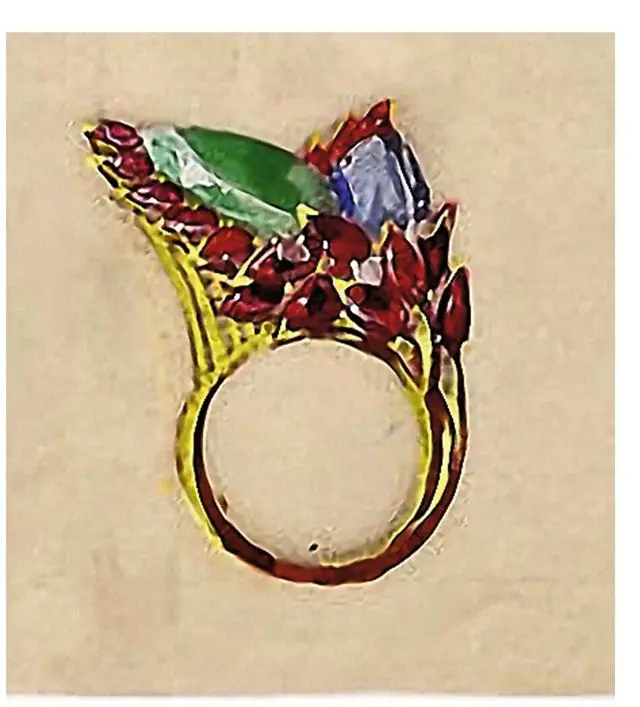
Design for a ring with rubies and an emeraldA gouache design for a ring: a broad gold shank crowned with a spray of red marquises and a green and a blue stone. The drawing conveys volume through shading along the inner curve of the shank.
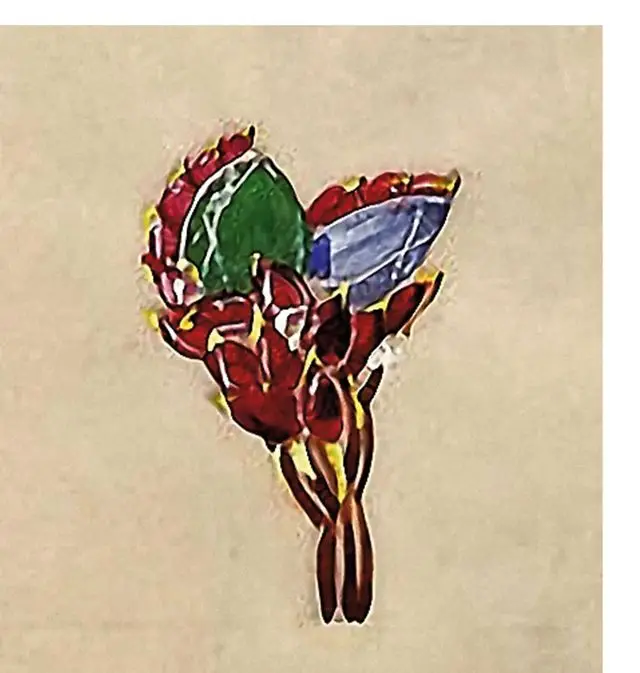
Design for a spray brooch with marquise stonesA gouache design for a brooch: three large marquise-cut stones — red, green and blue — fan out from a gold knot, surrounded by small red stones and diamonds.
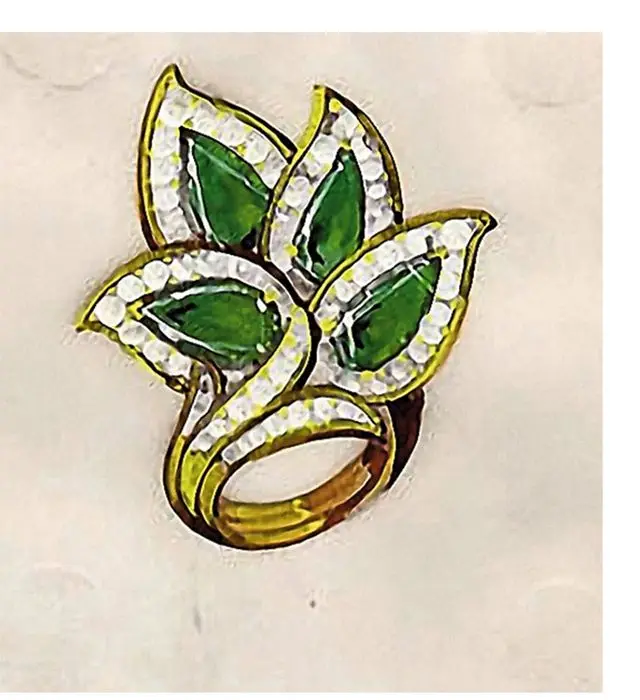
Design for a leaf brooch with emeraldsA gouache design on tinted paper: a brooch of three leaves set with pear-cut emeralds in diamond borders, the stem curling into a broad gold ribbon. Highlights on the stones are picked out in white — this is how the house showed a client a piece that did not yet exist.
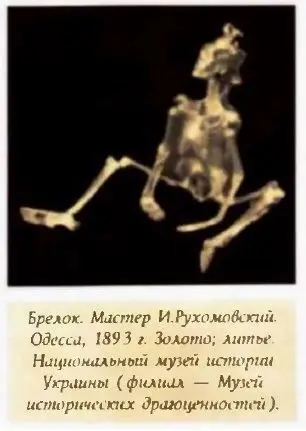
Gold fob by Israel Rukhomovsky, 1893A cast gold fob in the form of a fantastical winged creature with elongated limbs, photographed against black. The work of the master Israel Rukhomovsky, Odesa, 1893.
This is NOT a product of Marshak's factory. Rukhomovsky is the Odesa goldsmith whose "Tiara of Saitaphernes" entered the Louvre in 1896 as an ancient antiquity and became one of the loudest forgeries in museum history. The piece is included here as context: Ukrainian goldsmithing at the end of the nineteenth century was not confined to Kyiv.
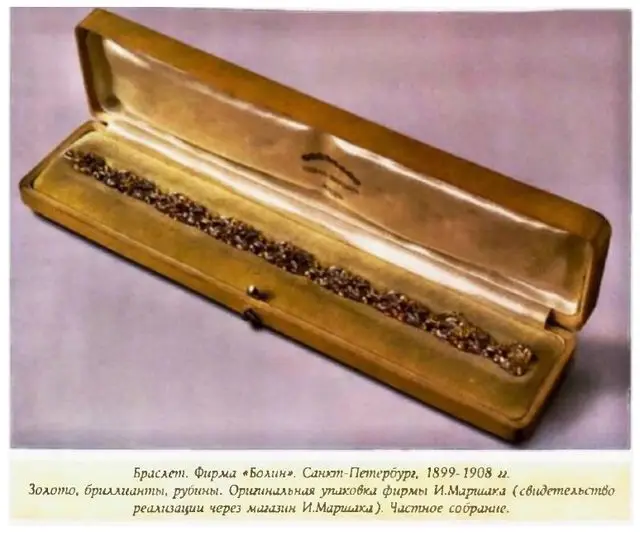
A Bolin bracelet in Marshak's own firm boxA gold bracelet set with diamonds and rubies by the St Petersburg firm of Bolin (1899–1908), lying in the open original box of Josef Marshak's firm. It is rare material proof that Marshak's Kyiv shop sold not only its own production but also pieces by the empire's leading jewellers. Private collection.
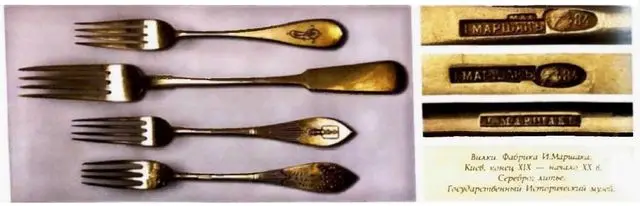
Table forks and three variants of the markFour silver table forks with plain stems and engraved owners' monograms, laid out in a fan. To the right are three macro shots of the "И.МАРШАКЪ" mark in different punch variants together with assay marks — precisely what pieces from the factory are attributed by. Kyiv, late nineteenth to early twentieth century. Held by the State Historical Museum.
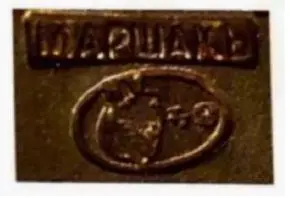
The "МАРШАКЪ" mark on a silver piece, macroA macro shot of two strikes in the metal: the rectangular "МАРШАКЪ" punch and, below it, the oval assay mark with a woman's head in a kokoshnik and the standard number. A strike like this is the only thing that separates a piece from Marshak's factory from anonymous silver of the period.
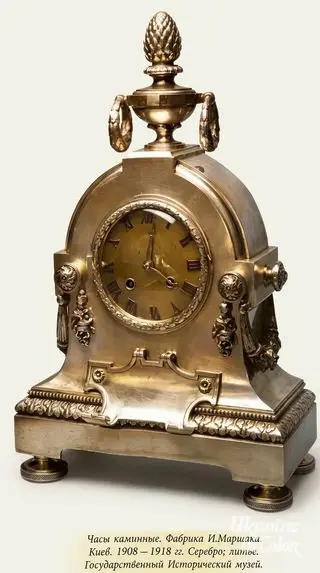
Mantel clockA mantel clock in cast silver in the classical taste: a rectangular case on bun feet, a round dial in a moulded frame, urns with rings and garlands at the sides, and a pinecone finial at the top. Kyiv, 1908–1918. Held by the State Historical Museum.
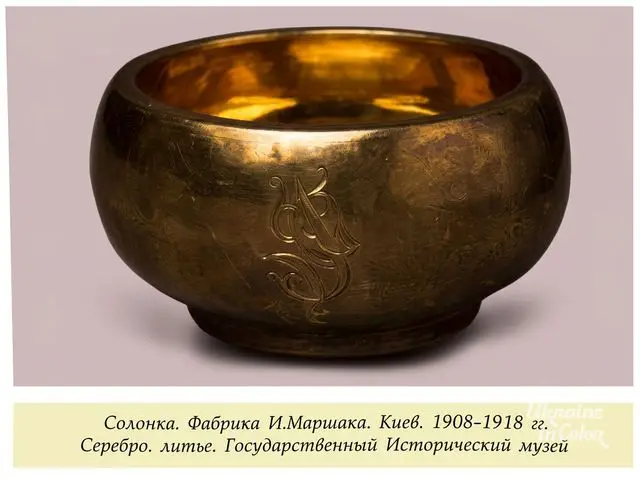
Silver salt cellar with a monogramA small round salt cellar in cast silver with plain walls and a gilt interior. An engraved monogram in an oval cartouche sits on the side. Kyiv, 1908–1918. Held by the State Historical Museum.
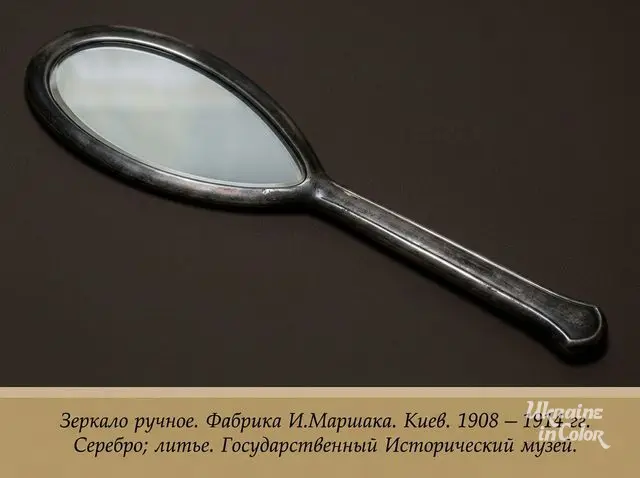
Silver hand mirrorA hand mirror in cast silver: an oval plate in a plain mount flowing into a short handle with a widened terminal. The form carries no ornament at all — the same spare Art Nouveau as the bonbon dish of 1899. Kyiv, 1908–1914. Held by the State Historical Museum.
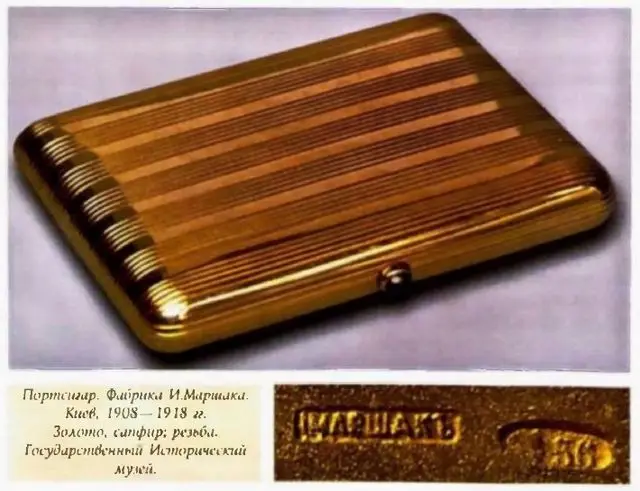
Gold cigarette case with a sapphireA gold cigarette case carved with parallel bands across the whole lid, alternating matt and polished gold. The clasp is crowned with a sapphire cabochon. The edge carries the mark "И.МАРШАКЪ" and the 56 zolotnik standard. Kyiv, 1908–1918. Held by the State Historical Museum.
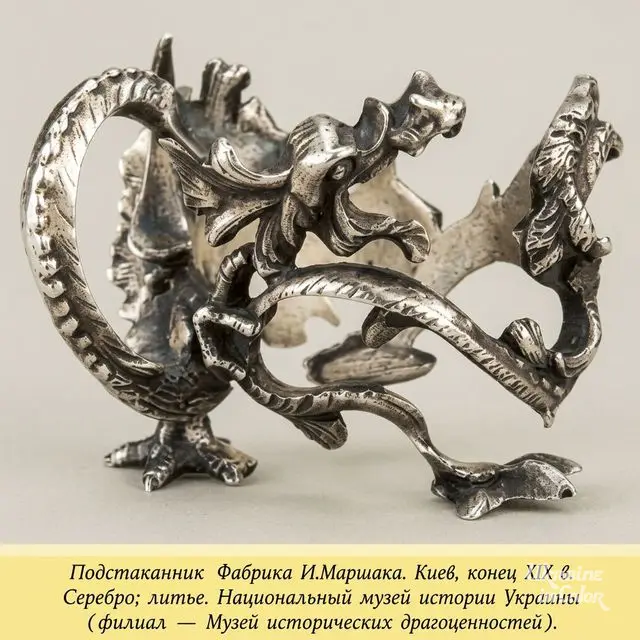
Tea-glass holder with dragonsA tea-glass holder cast as two winged dragons whose bodies and tails interlace into the rim while their open jaws and wings form the handle. Scales, wing membranes and claws are worked out in fine detail in the casting. Kyiv, late nineteenth century; silver, cast. Held by the National Museum of the History of Ukraine.
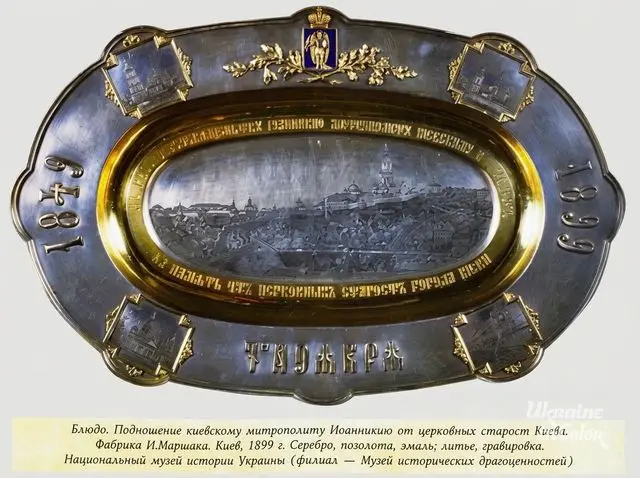
Salver presented to Metropolitan Ioannikii, 1899An oval salver of silver with gilding and enamel, cast and engraved. At the centre is an enamelled medallion with a panorama of Kyiv above the Dnipro and an inscription; the undulating rim carries cartouches, the dates "1849" and "1899" and a mitre at the top. Presented to Metropolitan Ioannikii of Kyiv by the city mayor and the civic community. Held by the National Museum of the History of Ukraine.
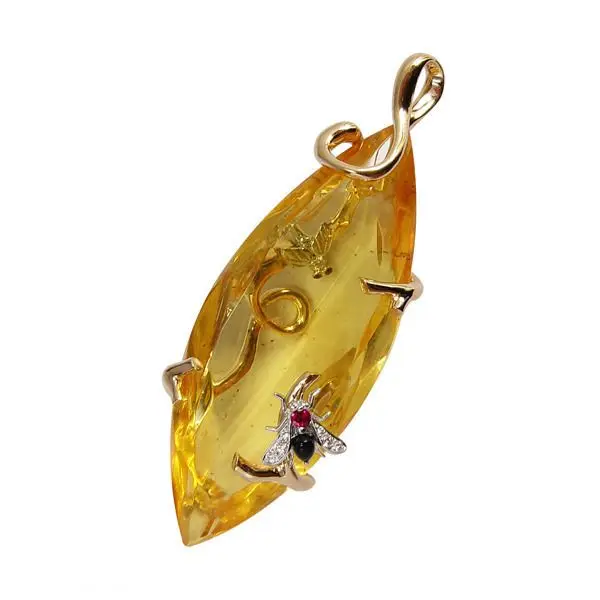
Pendant with a citrine and a gold lizardA pendant of elongated marquise-cut citrine in a gold mount. A small gold lizard with red eyes runs down over the surface of the stone; a gold bail for the chain sits at the top. Maison Marchak, Paris.
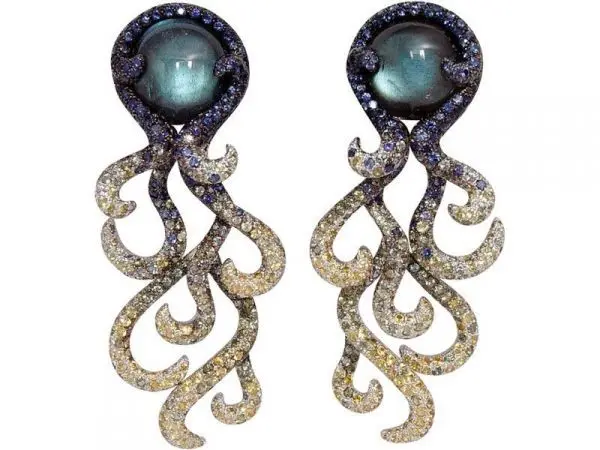
Octopus earrings with dark pearlsA pair of earrings: each is topped by a dark pearl ringed with blue stones, from which coiled tentacles fall, entirely paved with brown and white diamonds. Maison Marchak, Paris.
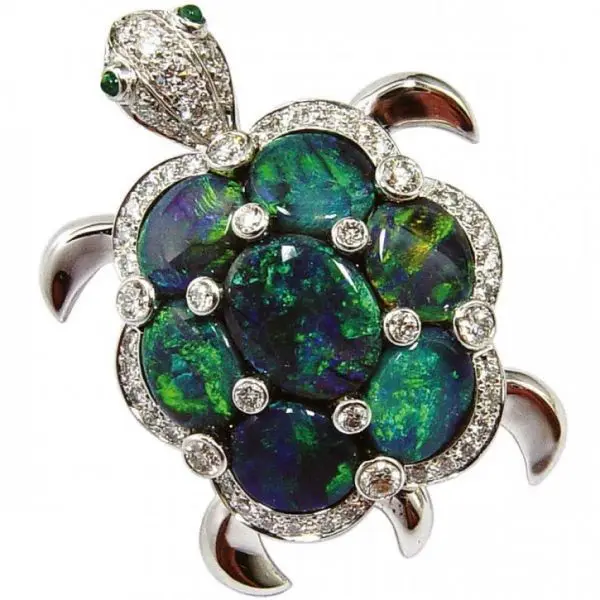
Turtle brooch with black opalsA brooch in the form of a turtle. The shell is laid with seven cabochons of black opal flashing green and blue, divided by diamonds. The head, feet and tail are white metal set with diamonds, and the eyes are green stones. Maison Marchak, Paris.
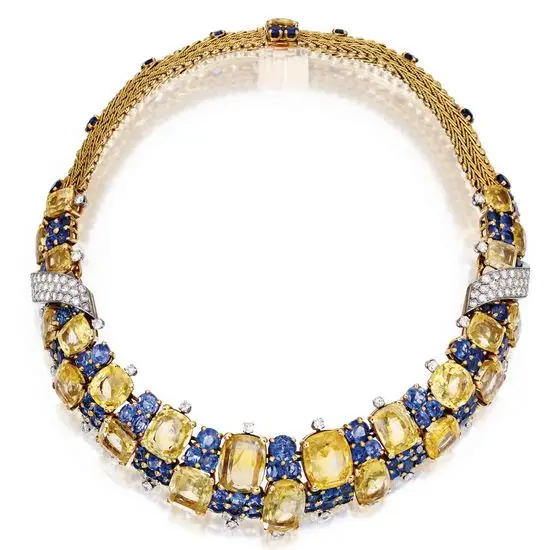
Collar necklace of blue and yellow sapphiresA rigid collar necklace alternating large rectangular yellow sapphires with clusters of blue stones in white settings along its whole length. The upper edge is bordered with a fine plaited gold wire. Maison Marchak, Paris.
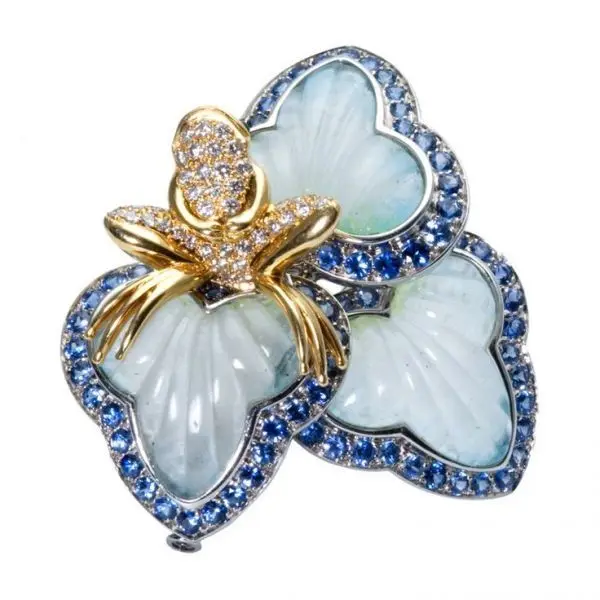
Orchid jewel in carved stoneA jewel in the form of an orchid: three broad petals carved from pale blue stone with fine veining and outlined with blue sapphires. The heart is finished with a gold column set with diamonds. Maison Marchak, Paris.
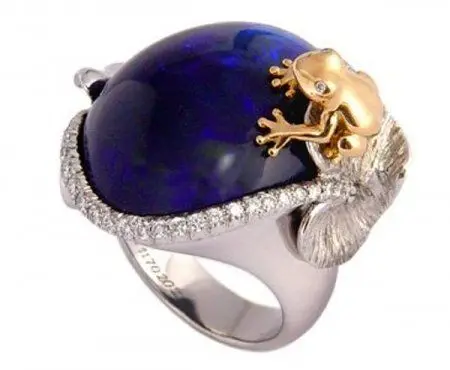
Ring with a dark opal and a gold frogA ring with a large cabochon of dark blue opal framed in diamonds. A small rose gold frog climbs up over the stone; the shank is white with a diamond line. Maison Marchak, Paris.
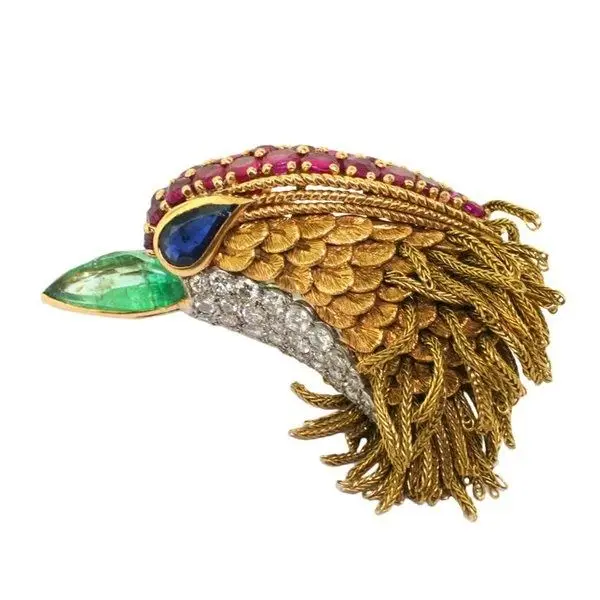
Bird brooch with gold plumageA brooch in the form of a bird's head and breast. The plumage is built from hundreds of small gold scales resolving into long flexible tassels; the breast is accented by a red cabochon with a diamond at its centre, and the beak runs into a large emerald drop. Maison Marchak, Paris.
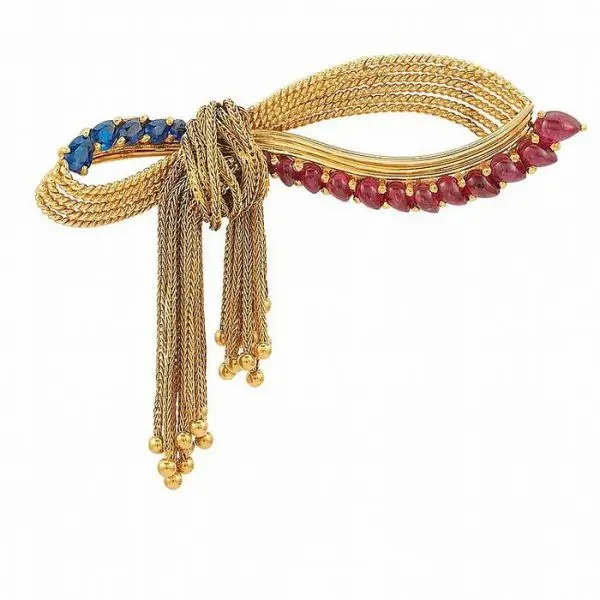
Bow brooch with gold tasselsA brooch in the form of a tied bow of plaited gold cord whose ends fall as two tassels. One loop is edged with blue sapphires, the other with red rubies, so that the bow reads as a two-coloured ribbon. Maison Marchak, Paris.
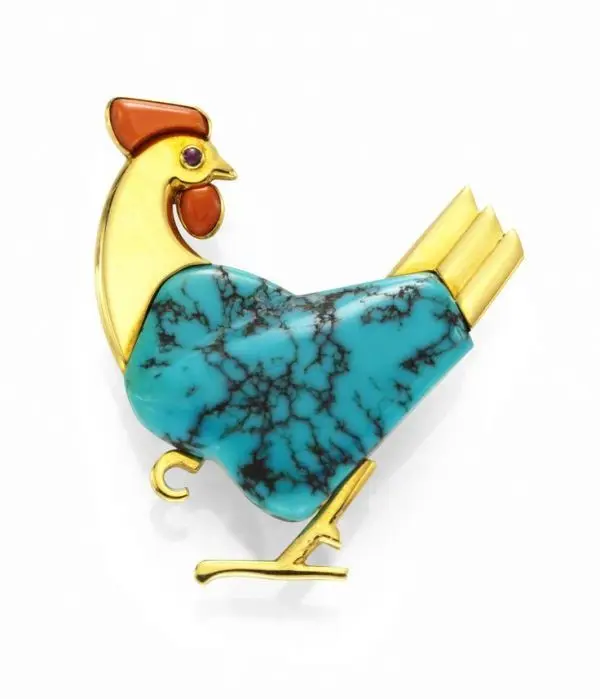
Turquoise cockerel broochA brooch in the form of a cockerel in profile. The body and tail are carved from turquoise with dark veining, the comb and wattle are red stone, and the beak, feet and flight feathers are smooth yellow gold. The eye is marked with a small dark stone. Maison Marchak, Paris.