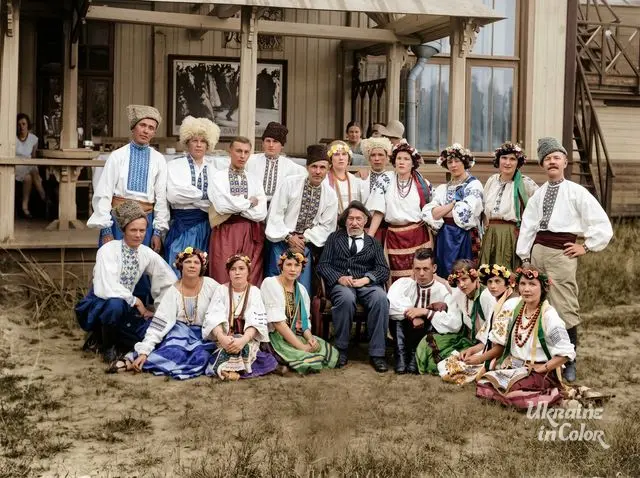
Ilya Repin with a choir that performed for him outside his villa Penaty in KuokkalaArchival photograph, 1929: Ilya Repin together with a folk-costumed choir that performed for him in front of his Penaty villa in Kuokkala. From the Finnish National Gallery (archive collections); photographer unknown; public domain.
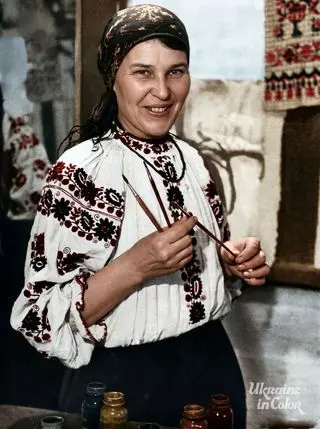
Maria Prymachenko at work in a vyshyvankaBlack-and-white portrait of Maria Prymachenko at work in her studio. The artist wears a dark headscarf and an embroidered blouse with dense floral ornament across the chest and sleeves, holding paintbrushes in her right hand. Jars of paint sit on the table in front of her. In the background are floral wall paintings inside her home-studio in Bolotnia village, Kyiv region. Probably 1940s–1950s.
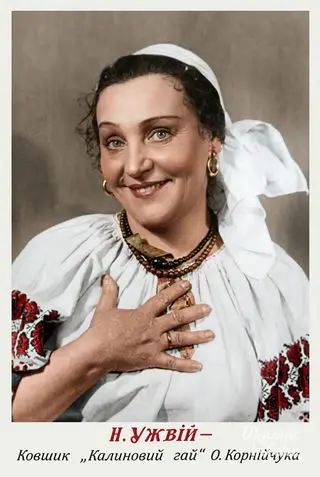
Natalia Uzhviy in the role of Kovshyk in 'Kalynovyi Hai' by O. KorniychukTheatrical studio photograph of Natalia Uzhviy in the role of Kovshyk in Oleksandr Korniychuk's play 'Kalynovyi Hai': in a white embroidered shirt with a plant pattern, with a beaded necklace and round earrings, a white headscarf tied behind her head. She smiles with her hands folded on her chest. Below is a printed caption: 'N. UZHVIY — Kovshyk "Kalynovyi Hai" by O. Korniychuk'. Taken during her active years at the Kyiv Ivan Franko Theatre.
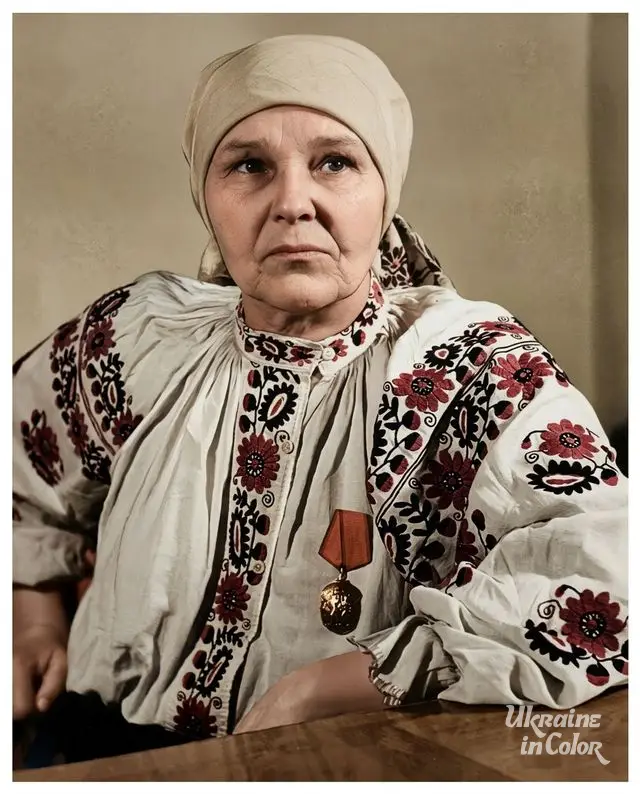
Maria Prymachenko — portrait with a medal in a vyshyvankaHalf-length portrait of an elderly Maria Prymachenko: in a white headscarf tied under the chin and an embroidered shirt with a rich plant pattern — sunflowers and winding stems across the chest and sleeves. On her chest is a medal on a ribbon, most likely the Shevchenko Prize award or the Honoured Art Worker of the Ukrainian SSR. She sits with her forearm resting on a table.
Olena Pchilka in her youth — studio portraitStudio half-length portrait of young Olena Pchilka (Olha Drahomanova-Kosach): in a white embroidered shirt with an openwork pattern and a dark waistcoat with a small floral ornament, with several strands of beaded necklaces around her neck. She is shown in three-quarter pose, with one hand holding a flower and resting on a stone plinth. The background is a studio backdrop.
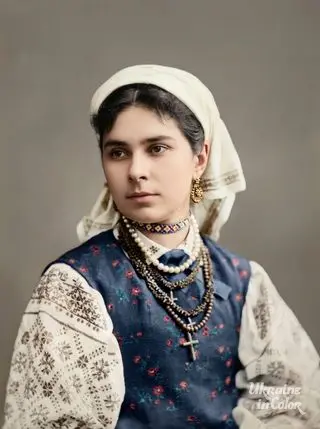
Liudmyla Drahomanova in a headscarf and beaded necklacesStudio portrait of young Liudmyla Drahomanova: in a white headscarf tied in the classical Ukrainian manner, an embroidered shirt with an openwork pattern on the sleeves and a dark waistcoat with a small floral pattern. Around her neck are several strands of beaded necklaces, among them dukachi (coin pendants) and a small cross. A pendant earring hangs from her ear.
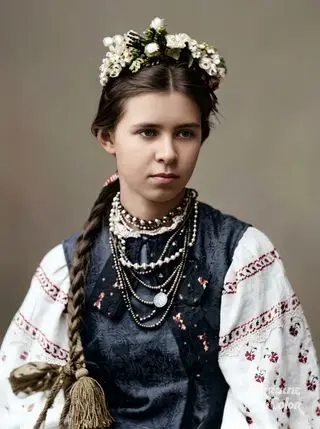
Lesya Ukrainka in a floral wreathStudio portrait of young Lesya Ukrainka in a wreath of wildflowers with a dark ribbon, with a long braid over her shoulder, wearing an embroidered shirt and a dark bodice, with several strands of beaded necklaces. One of the canonical photographs of the poet in Ukrainian folk dress from her early creative period.
Lesya Ukrainka in her youth with flowersStudio portrait of young Lesya Ukrainka: in a dark embroidered blouse with a dense floral pattern and wide white sleeves with geometric openwork embroidery, wearing a beaded necklace and an embroidered ribbon at the throat. She leans her left arm on a studio pedestal where a bouquet of wildflowers rests. One of the best-known photographs of the poet as a young woman.
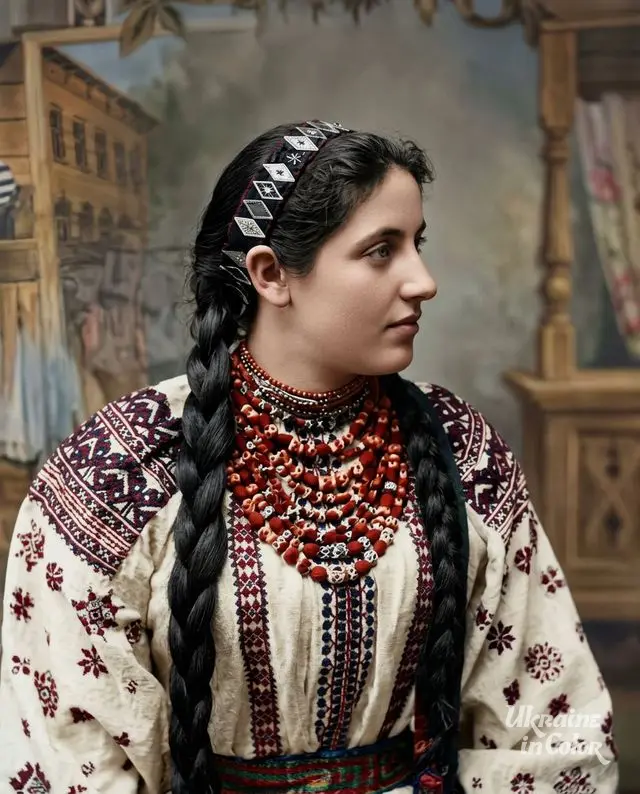
Solomiya Krushelnytska — profile with braid in a vyshyvankaSepia profile portrait of Solomiya Krushelnytska: a long braid thrown over her shoulder, an embroidered band with a geometric pattern on her head, an embroidered shirt with dense ornament across the chest, and a beaded necklace. The silhouette of a building is visible in the background. A photograph from the early period of her career.
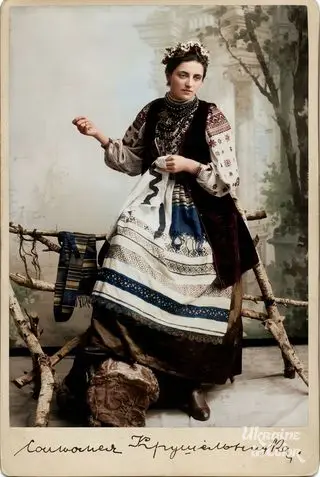
Solomiya Krushelnytska — signed full-length portraitFull-length studio portrait of the opera singer Solomiya Krushelnytska in elaborate Ukrainian dress: an embroidered shirt with a geometric pattern, a dark waistcoat, a festive ornamented apron, a floral wreath and beaded necklace. She stands beside a wooden fence in a studio setting. At the bottom is her handwritten signature 'Solomeya Krushelnytska'.
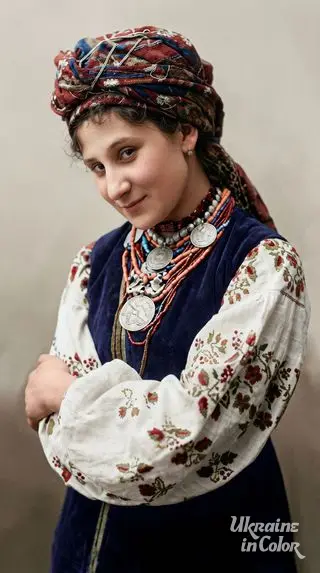
Maria Zankovetska — cabinet portrait in a vyshyvankaStudio cabinet portrait of the actress Maria Zankovetska: in an embroidered blouse with billowing sleeves, a dark waistcoat, a floral headdress and a beaded necklace, with a slight smile and her face turned toward the viewer. A photograph from the years of her active stage career with the Ukrainian travelling troupes.
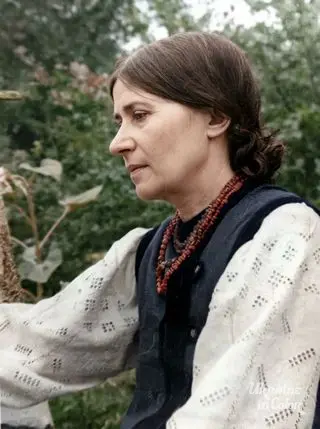
Kateryna Bilokur — half-length portrait in a vyshyvankaHalf-length profile portrait of Kateryna Bilokur in a white embroidered blouse with an openwork pattern and a dark waistcoat, with a beaded necklace, against the greenery of her garden. A mid-life photograph.
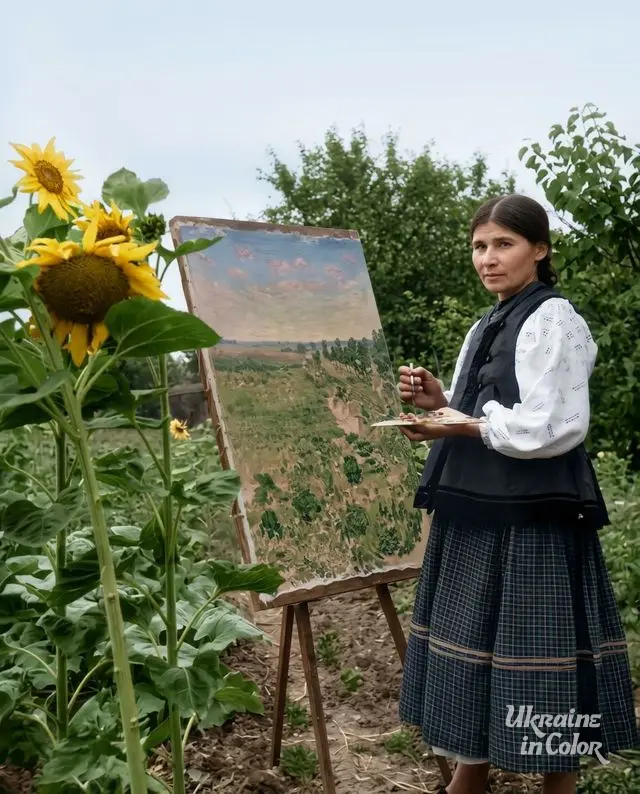
Kateryna Bilokur at her easel in the gardenKateryna Bilokur paints a floral still life with sunflowers at her easel amid her garden in Bohdanivka. The artist wears a dark waistcoat over an embroidered blouse and a checked skirt. One of the most recognizable photographs of her working in her natural setting.
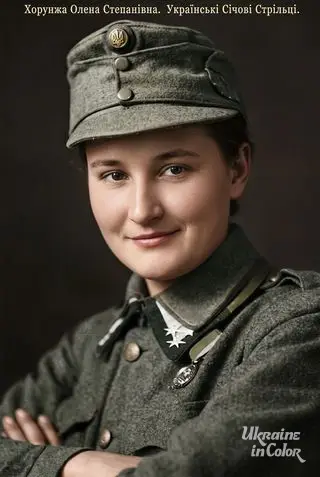
Postcard portrait: 'Khorunzha Olena Stepanivna. Ukrainian Sich Riflemen', c. 1915A sepia-toned patriotic postcard portrait of Olena Stepaniv from the First World War period. The upper portion bears a printed Ukrainian inscription: 'Khorunzha Olena Stepanivna. Ukrainian Sich Riflemen.' She is shown in USS uniform: a mazepynka cap with cockade, a tunic with embroidered collar; on her chest are her decorations: on her left (the viewer's left) — the silver Austro-Hungarian Medal for Bravery awarded on 10 November 1914 for her role in the Carpathian Campaign; on her right — the insignia of the Ukrainian Sich Riflemen. Likely published in Lviv c. 1915 for patriotic distribution. The original is held by the Museum of Military History (Heeresgeschichtliches Museum) in Vienna, inv. no. 2010_42_738_104.
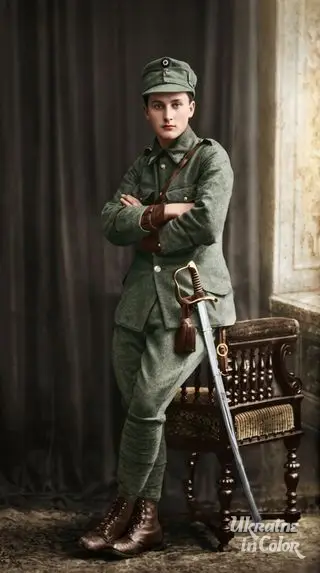
Studio portrait of Olena Stepaniv with saber and decoration on her sleeve, in USS uniform, c. 1914–1915Full-length studio portrait of Olena Stepaniv in the uniform of the Ukrainian Sich Riflemen: a mazepynka cap with cockade, a tunic with breast pocket, breeches with puttees, and high lace-up boots. She stands with arms crossed on her chest, her right hand resting on an officer's saber stood vertically on the floor. A decoration ribbon is visible on her left sleeve — likely the silver Austro-Hungarian Medal for Bravery she was awarded on 10 November 1914 for her role in the Carpathian Campaign. The backdrop is a studio curtain on the right and a wicker chair on the left. A photographer's stamp is visible in the lower-right corner.
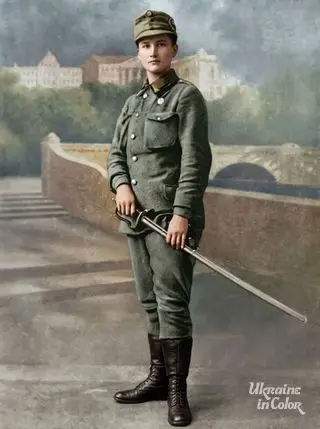
Full-length studio portrait of Olena Stepaniv with a saber, in USS uniform, c. 1914–1915Full-length studio portrait of Olena Stepaniv in the uniform of the Ukrainian Sich Riflemen: a mazepynka cap with cockade, a tunic with breast pocket, breeches with puttees and boots. In her right hand is an officer's saber. The backdrop is a painted studio scene with a balustrade and park architecture. Likely taken in Lviv in 1914–1915, during her active service with the USS before her capture by Russian forces in May 1915.
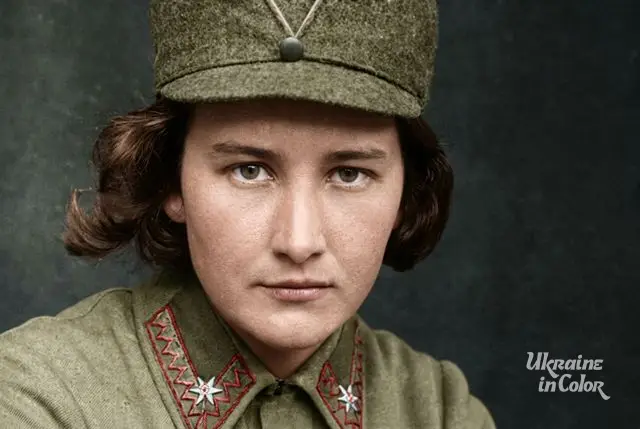
Studio portrait of USS officer (khorunzha) Olena Stepaniv, c. 1914–1915Studio portrait of Olena Stepaniv in the uniform of a khorunzha (junior officer) of the Ukrainian Sich Riflemen (USS). The eight-pointed star insignia on the collar tabs marks USS officer rank; the mazepynka cap bears a central cockade. The tunic collar is decorated with traditional Ukrainian embroidery. The photograph was likely taken in Lviv during her period of active service (1914–1915), before her capture by Russian forces near Bolekhov in May 1915.
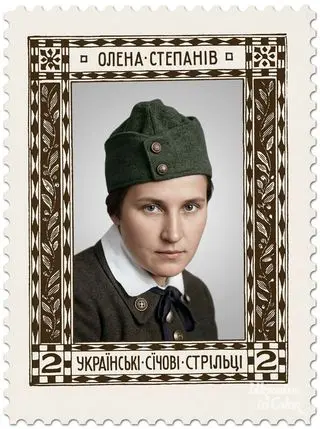
Postage stamp featuring Olena StepanivPostage stamp featuring Olena Stepaniv — part of a series dedicated to prominent Ukrainian women and figures of the Ukrainian Sich Riflemen.
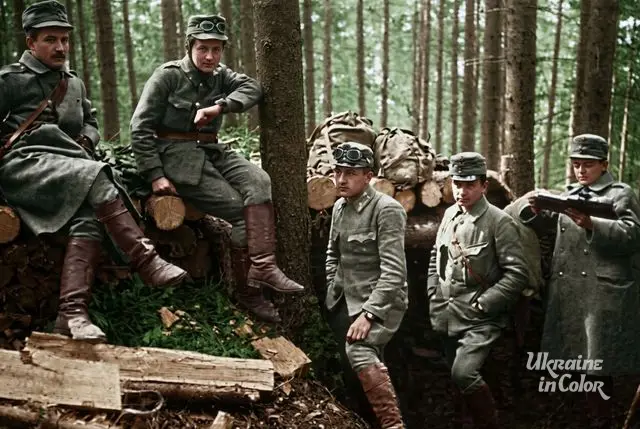
USS Officers on Mount Makivka: Zenon Noskovskyi, Olena Stepaniv, Ivan Chmola, Osyp Yarymovych, Sofia HalechkoOfficers of the Ukrainian Sich Riflemen on Mount Makivka: Zenon Noskovskyi, Olena Stepaniv, Ivan Chmola, Osyp Yarymovych, and Sofia Halechko. Mount Makivka (Skole Beskids, Carpathians) was the site of the USS battle against Russian forces in April–May 1915, in which Olena Stepaniv participated and for which she received the silver Medal for Bravery.
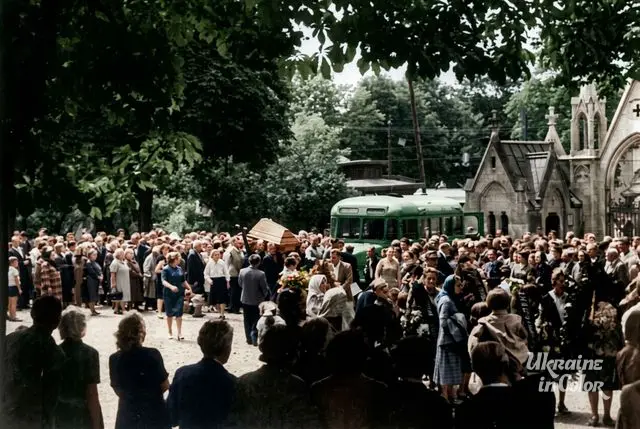
Funeral of Olena Stepaniv at Lychakiv Cemetery, July 13, 1963The funeral of Olena Stepaniv at Lychakiv Cemetery in Lviv, July 13, 1963. She died of cancer on July 11, 1963, in Lviv.
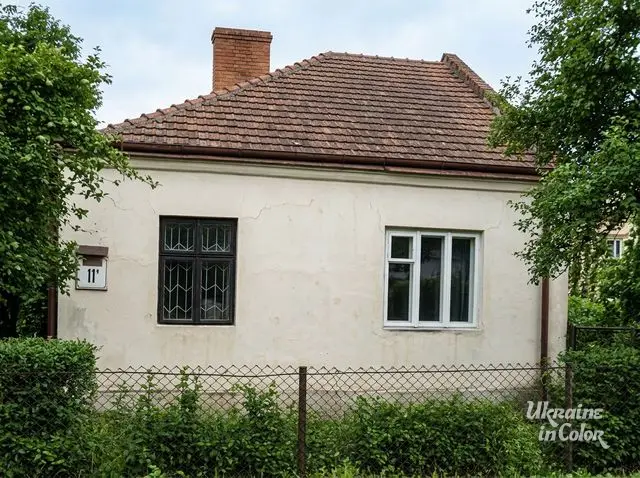
House at 11A Kozatska Street, Lviv, where Olena Stepaniv lived after the campsHouse at 11A Kozatska Street, Lviv, where Olena Stepaniv lived with her son Yaroslav Dashkevych after her return from the Mordovian camps. Photograph from the 1960s.
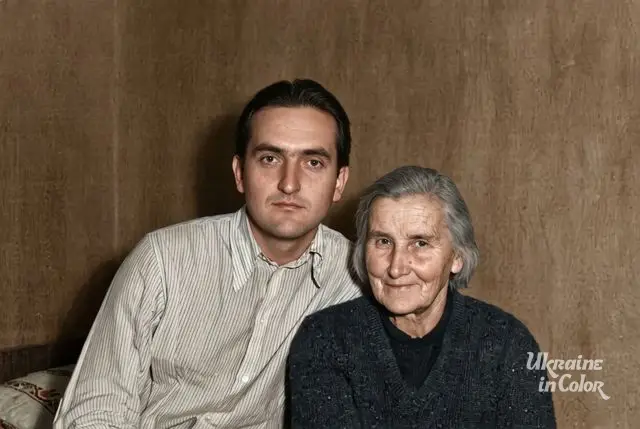
Olena Stepaniv with her son Yaroslav Dashkevych, 1958Photograph of Olena Stepaniv with her son, historian Yaroslav Dashkevych (1926–2010), taken in 1958, after her release from the Mordovian labor camps (1949–1956).
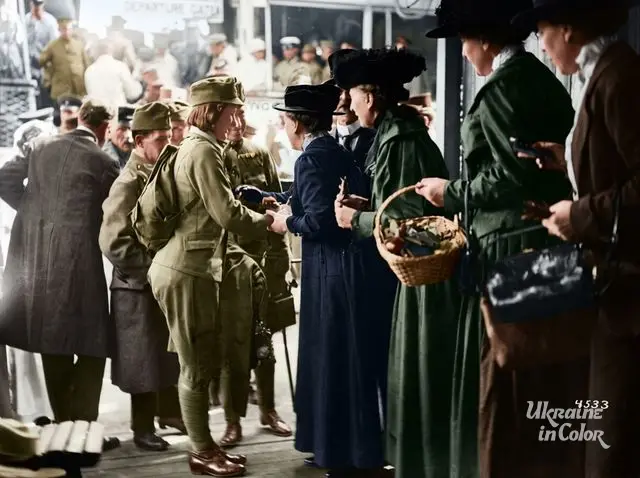
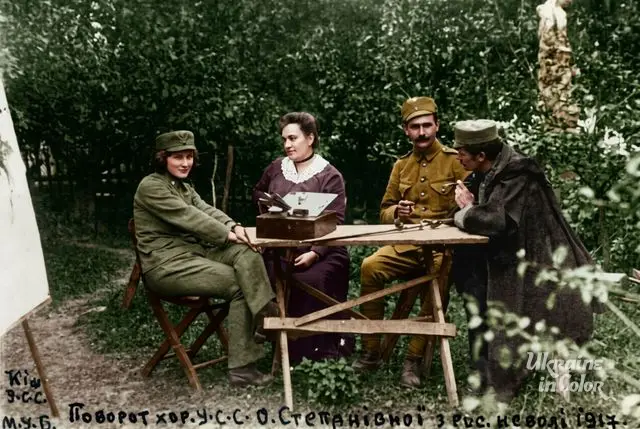
The return of Olena Stepaniv from Russian captivity, 1917Photograph taken during the return of Olena Stepaniv from Russian captivity (Tashkent → Europe) in July 1917.
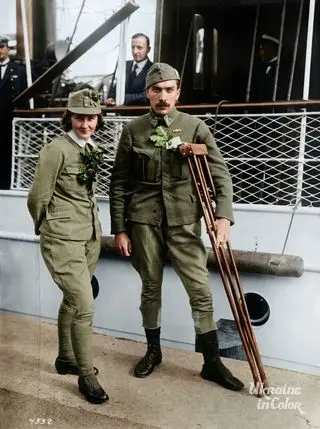
Olena Stepaniv with a wounded officer in Tornio during her return from captivity, summer 1917Olena Stepaniv with a wounded officer in Tornio (then the Finnish-Swedish border station on the prisoner-exchange route) during her return from Russian captivity, summer 1917.
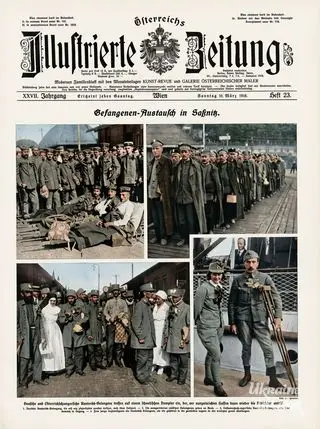
Front page of an Austrian periodical featuring Olena Stepaniv after her return from captivityFront page of an Austrian periodical with a photograph of Olena Stepaniv during her return from Russian captivity (1917). The document illustrates the attention her story received in the European press.
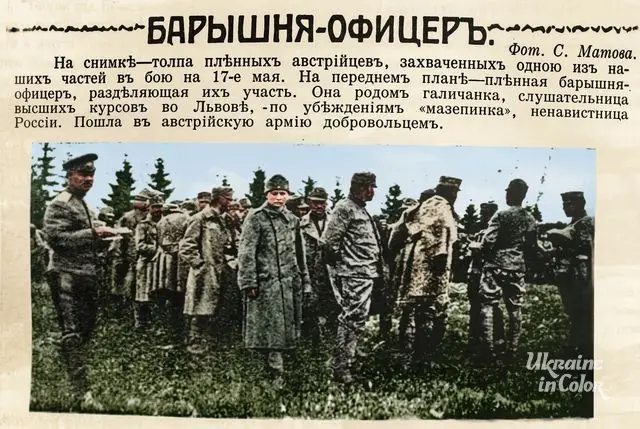
Russian newspaper clipping 'Baryshnya-Ofitser' about the capture of Olena StepanivClipping from a Russian newspaper headlined 'Baryshnya-Ofitser' ('The Lady Officer') — a report on the capture of Olena Stepaniv by Russian forces near Bolekhov on May 17, 1915. The document reflects the resonance her story had in the Russian press.
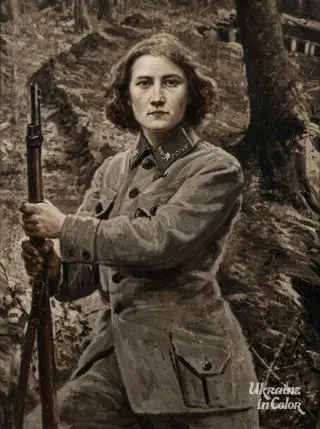
Portrait of Olena Stepaniv by Osyp KurylasPainted portrait of Olena Stepaniv by Ukrainian artist Osyp Kurylas (1870–1951), who himself served in the Ukrainian Sich Riflemen and created numerous portraits of the riflemen and the USS gallery.
Olena Stepaniv at the USS Kosh in Pisochna over the Dniester, September 1917Olena Stepaniv (left) at the Ukrainian Sich Riflemen training camp (Kosh) in Pisochna on the Dniester, September 1917, shortly after her return from Russian captivity.
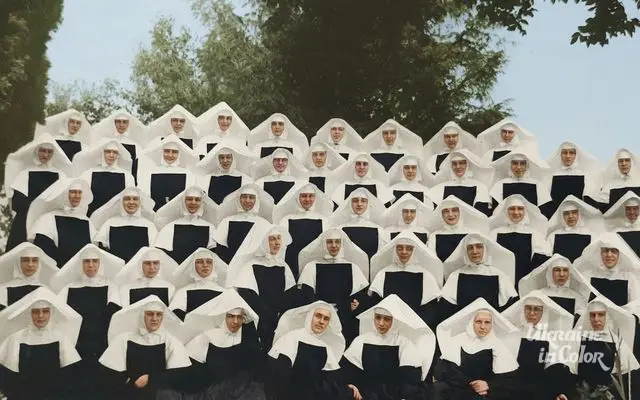
Order of the Sisters of Charity of St. Vincent de PaulThis Catholic women's congregation was founded in the 17th century in Paris to serve the poor, sick, and disadvantaged. A monastery was established in Zhytomyr in 1766.
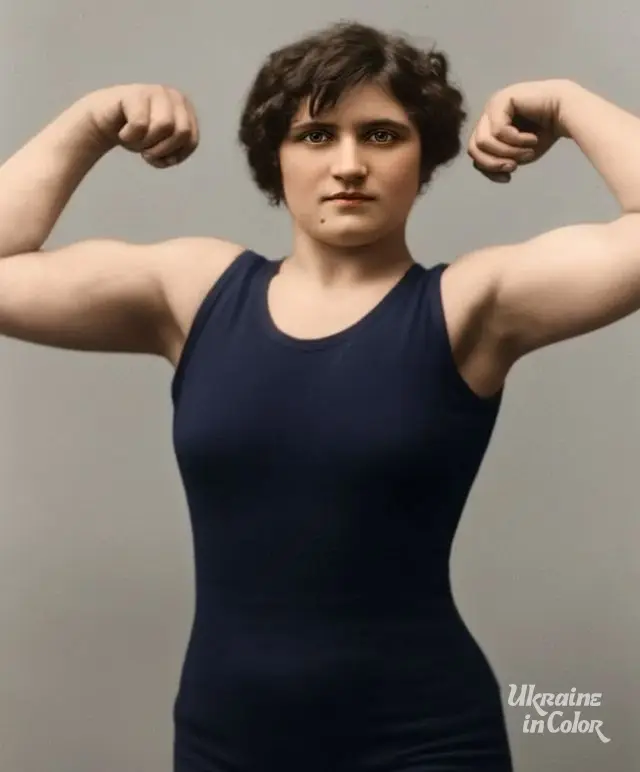
World champion in classical women's wrestling (1915) - Maria Yakymovna KovacIn 1913 she came to Odessa to earn money. On the recommendation of friends she moved to study with famous wrestlers in St. Petersburg, where she signed a contract to perform at women's championships, in circuses, and theaters. During performances she bent iron with her teeth, lay down under the platform over which a car was passing. In 1914 she defeated the Scottish ring star Kelt, the Bulgarian Glovcheva, the Romanian Vasilescu, in 1915 in Kyiv—the world champion K. Giraldi from Revel (now Tallinn). At the beginning of World War I she moved to the city of Zhmerynka (now Vinnytsia Oblast), graduated from medical courses. In 1917–22 she worked as a nurse (in particular in the Hnivan hospital); in 1922–23—a typist of the Hnivan city executive committee, in 1937–59—a Vinnytsia Oblast sugar trust. I did not return to sports.